
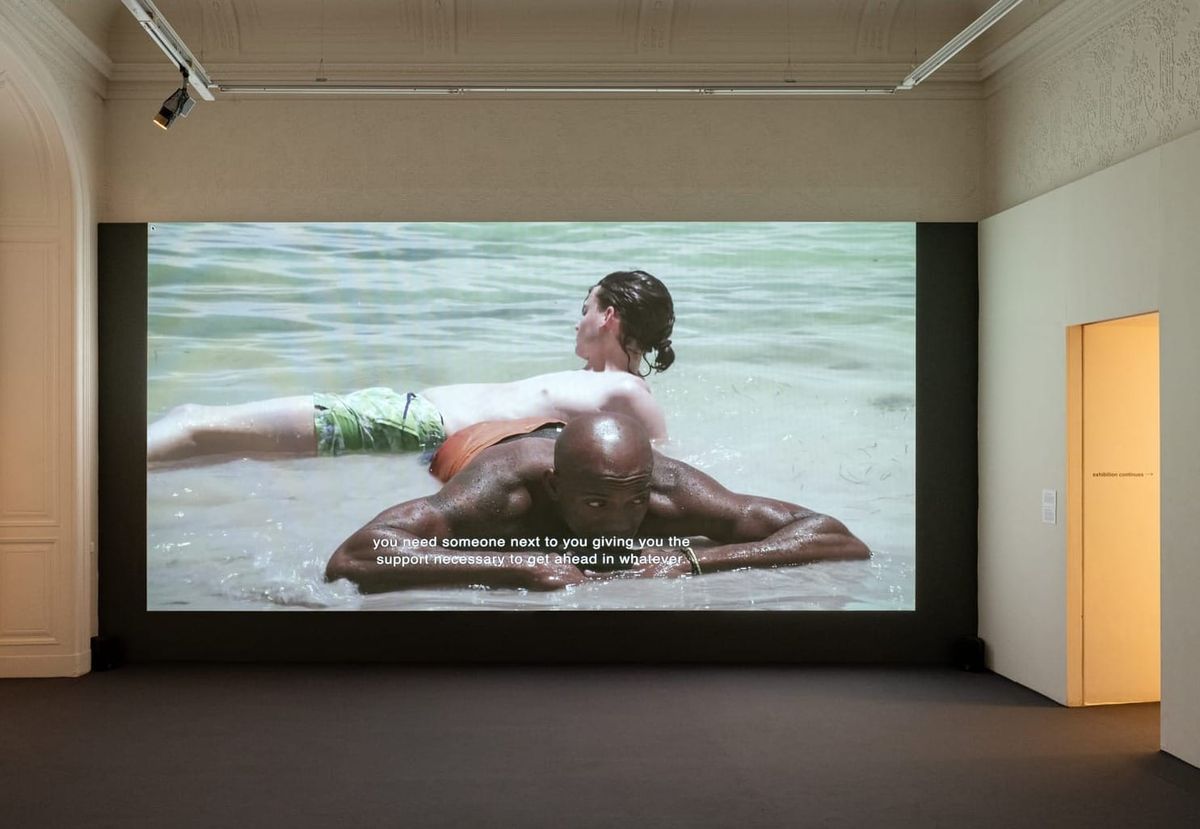
The problem with love in art is that its current practices repeatedly assert that love is political without ever locating the politics. A Marxist-Feminist lens can give it back its relation to the world rather than keeping it a private sentiment: care keeps being labor; intimacy and commodification are opposites; art is dependent on invisible reproductive work; and there is an awkward but productive fact in a festival staged through commercial galleries asking whether anything can escape exchange value. It also makes the questions less deferential and allows the answers to acknowledge contradictions instead of dissolving them into “connection”, “sharing”, and “care”.
I want to start with Alexandra Kollontai, who said that “essentially, love is a profoundly social emotion. That feels important to state today. It recognizes the rights and integrity of the other’s personality, as well as steadfast mutual support and sensitive sympathy.” In this spirit, why love, why now, and what does it bring to the table?
AFF & CL: We did not want love to function simply as the optimistic opposite of the current geopolitical conditions or as consolation. What interested us, and the participating galleries, was whether love could instead become a way of examining the world today.
In that sense, LOVE, all in caps, is less an answer than a pressure applied to the present. Love is universal. Universally understood, yet so personal.
Every year, it is curated by inviting international curators to respond to a distinct theme in the form of an exhibition to reflect on the most pressing issues of our time. The theme is collectively chosen by the participating galleries, who are also the ones proposing different topics and ideas. Collectively, when the theme of LOVE, in capital letters as we write it across our communications, was voted on, we all thought it was very interesting, in a moment where politics are characterized by militarization, xenophobia, and fear, to approach the problem antithetically, hoping this might prove a response or a tool to observe the present.
Love is not only a theme or a feeling, not a politics of the heart or a politics of charity, but a verb: it incites action. What does it mean for you, as curated by’s directors, to use love as a curatorial method, rather than simply a subject the works address?
AFF: Curating is necessarily relational. It begins with an attachment to art and to artists, but also with the responsibility of facilitating somebody else’s vision. It means giving time and attention to something that is not entirely yours and accepting a degree of responsibility for the conditions in which it becomes public.
CL: The Latin word curare offers a useful point of departure: to care, to take care of, to attend to. Love as a curatorial method—and one for exhibition-making—means listening closely to artists and their ideas and facilitating the conditions for their visions to unfold. It is a practice of connection and making space for meaningful encounters between people, ideas, and works.
Could you walk us through how this took shape in this edition, perhaps through a specific decision?
AFF: For this 17th edition of the Festival, and our second as Directors, we have put collaboration and exchange with Vienna’s cultural landscape at the heart of our vision to make it a truly city-wide initiative. We are thrilled to be working closely with mumok (the Museum of Modern Art of the Ludwig Wien Institute), which is serving as our headquarters for the entire festival and hosting our opening weekend press conference and breakfast. This close partnership is just one reflection of our spirit of love and sharing.
CL: This intersection informed the artist- and curator-led tours, where cultural workers accompany audiences through the participating galleries, as well as the podcast series reflecting on curated by’s history. We were interested in creating situations in which the festival could be encountered not only as a sequence of objects in spaces, but as a network of relationships.
Kollontai’s radical proposition was that love changes when the social relations around it change. So rather than asking simply how each curator “interpreted” LOVE, I’m interested in what kinds of love the exhibitions actually produced: possessive love, romantic love, solidarity, grief, kinship, eroticism, dependency, care. Where did those definitions begin to conflict with one another?
AFF: The responses were very different, which mattered to us. Some exhibitions approached romantic or toxic love; others dealt with familial attachment, social care, grief, longing, or forms of collective relation.
CL: Each exhibition approached love from a different position, reflecting how complex and open the subject remains—politically, socially, and emotionally. As [the poet] Ariana Reines writes, “Love is an experience, not an object.” There is much to experience across the many interpretations and manifestations of this broad topic.
Were there works that changed the temperature of that argument for you personally—where love stopped being the festival’s conceptual frame and became something materially strange, difficult, or seductive, resisting an easy or redemptive reading of love?
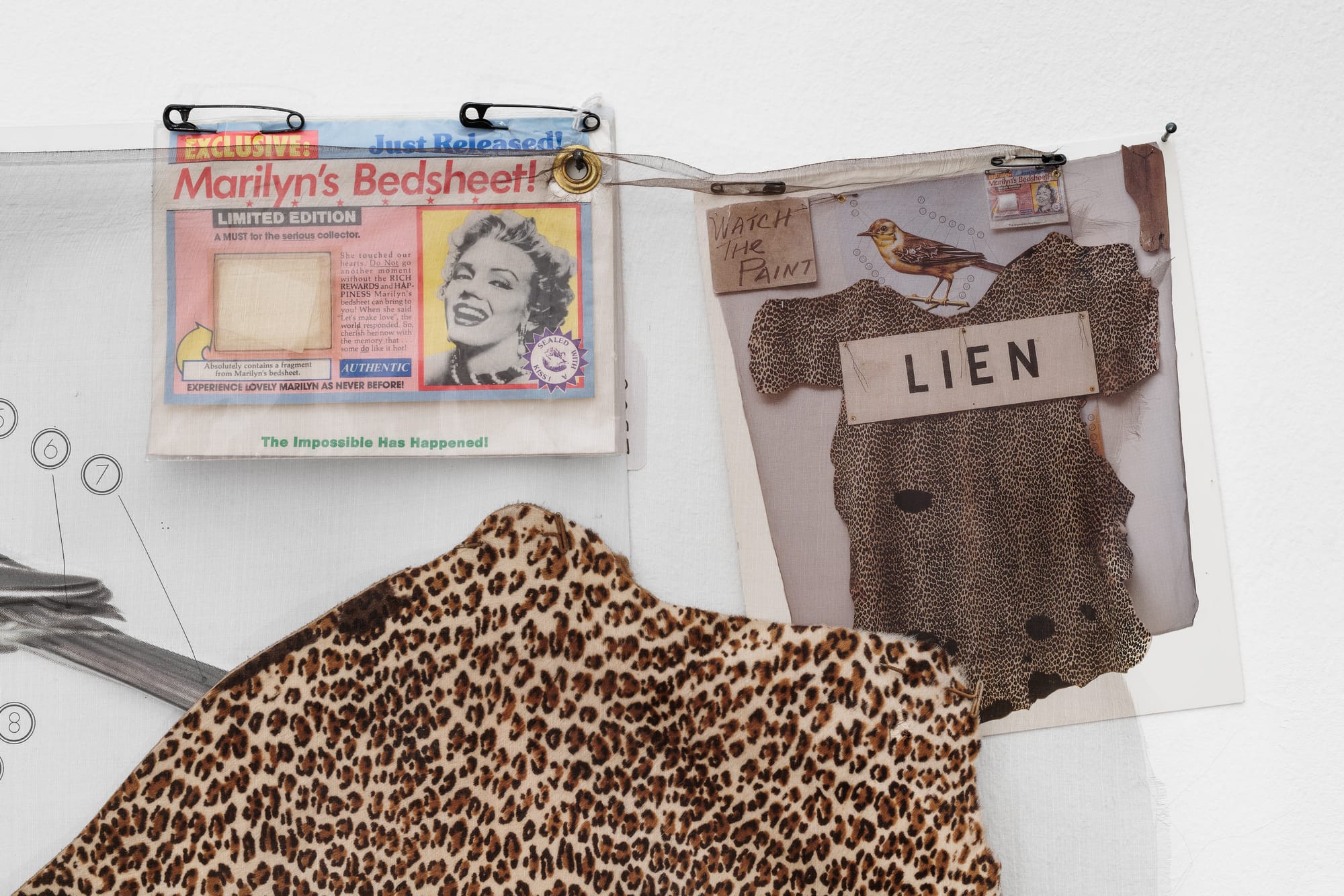
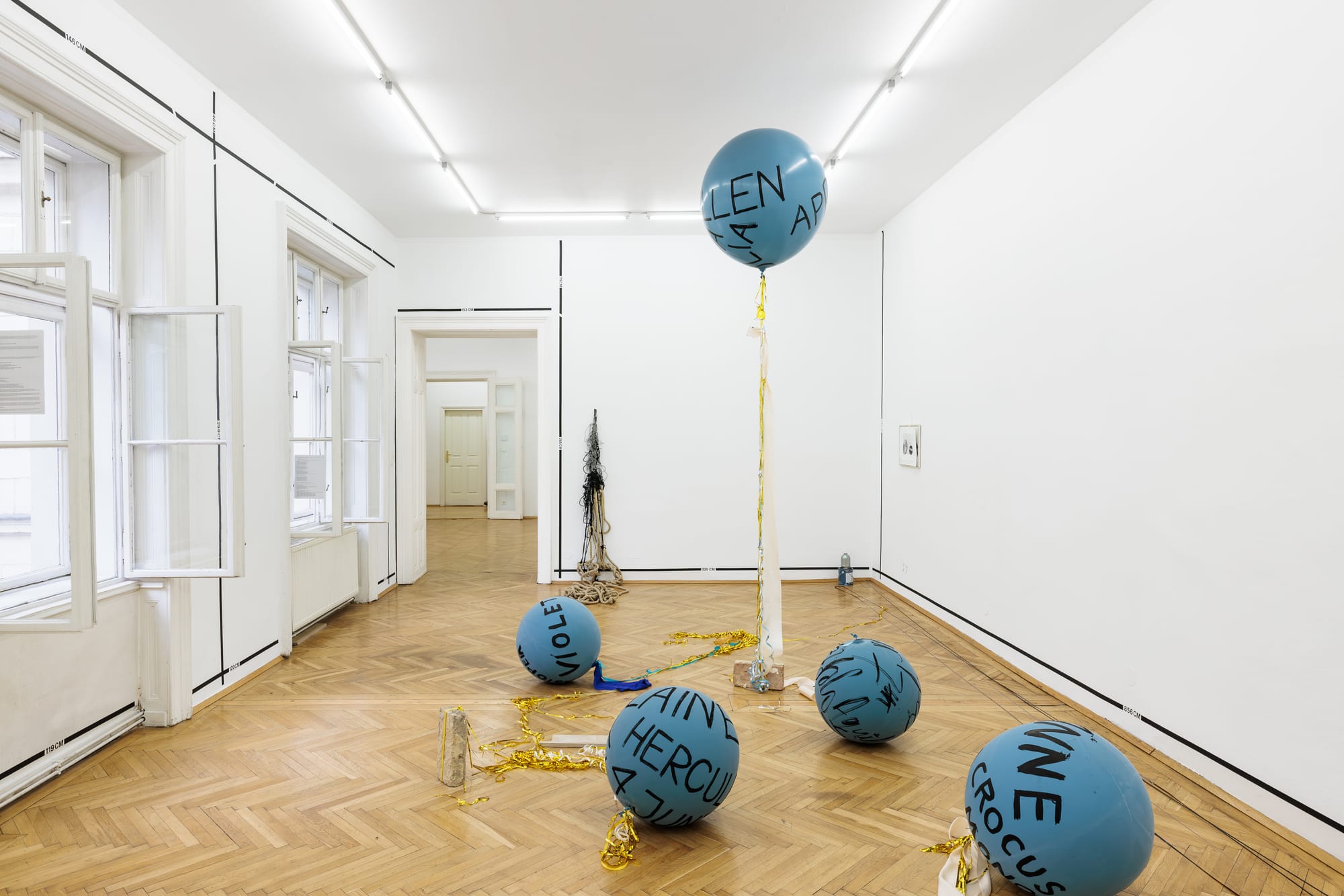
AFF: I would draw [attention] to the sacred quality of Valentin Noujaïm’s sculptures at GIANNI MANHATTAN and the extraordinary assemblages of Lenke Rothman at Croy Nielsen. Ian Wilson’s work at Martin Janda places artistic exchange itself at the center; at Exile, David Medalla’s posthumously discovered print blocks introduce questions of absence and of what survives; and Rosemary Mayer’s balloons, Connections (Vienna), in Jason Dodge’s exhibition at FELIX GAUDLITZ make connections simultaneously physical and fragile.
These works interested me because love does not necessarily appear in them as an image. It can exist as a structure between things: presence and absence, one person and another, an object and a memory.
CL: Many did, and in very different ways. Beyond the works Attilia has already mentioned, I would highlight the opening-weekend performances, which were particularly important in this regard. Adam Christensen, Jason Dodge and Sudden Wealth, and Ja Jess introduced a bodily, temporal, and ephemeral register, shifting “love” from a conceptual frame toward something more contingent, sensorial, and experiential.
I want to stay with the darker side of this. There is a tendency, particularly within cultural institutions, to make love synonymous with healing, community, and repair. But love is not inherently emancipatory. It can be possessive, disciplinary, fetishistic, even violent. Which works for you refused the fantasy that love necessarily redeems us?
AFF: The photographs of Hudinilson Jr. at Hubert Winter in the exhibition curated by Theo-Mario Coppola keep returning to me.
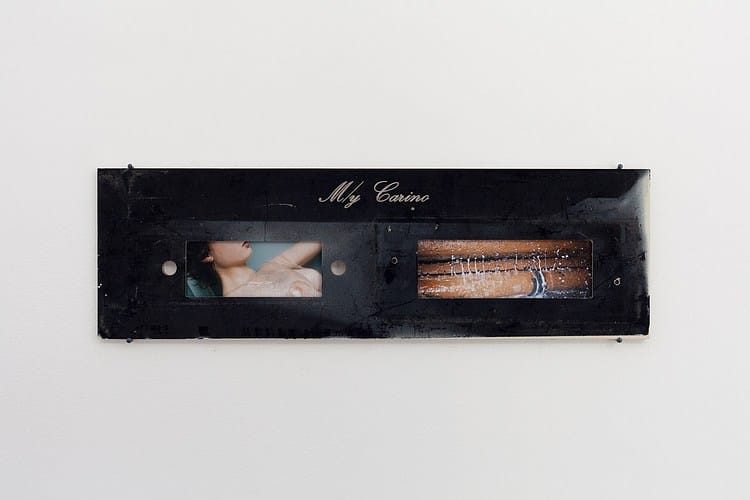
CL: I would add Giorgos Tigkas at Krobath, where sensuality and desire take on an ambiguous, fetishistic quality.
Zooming out to the stakes of the show as a whole: much of what is shaping our environments right now—from climate catastrophe to technological acceleration and militarization—is, in my view, the result of an ongoing lovelessness for the world. What vision was aimed to incite, resist, or cultivate through the exhibitions?
AFF & CL: To respond to this question, we would like to cite Ariana Reines, who wrote a beautiful essay to accompany the Festival:
"If you don’t know anything about love, try everything else, learn everything else that you can. You should find love enters your world naturally, organically—guiding and influencing what you do. But if you still don’t feel it—and many of us are too demoralized these days to feel much of anything—then you can lick Love’s plates by reading poetry.
An inherently epistolary art form, the lyric poem is practically made of friendship, of Eros, of Agape. It is made of the other—it is full to overflowing with everything it isn’t. Intoxicated with these enormities, the substance of poetry’s just a few words strung together. Hardly anything at all.
But it changes your heartbeat, reorients your soul, makes it possible to breathe when before you were suffocating, makes it possible to go on living in the face of unimaginable pain, gives you even the tiniest spark, all you need to overcome a feeling of deadness, the sensation of being widowed or abandoned in a reality that seems to be abdicating its every treasure to nonsense before even realizing what and why."
So perhaps the measure of the festival is not whether audiences leave feeling “loved”, but whether their relation to something has shifted. What kind of experience did you want to produce?
CL: Perhaps an unexpected sense of connection.
AFF: Catharsis.
//