
Twenty-five years after the attacks of September 11, the political order consolidated through the “War on Terror” continues to shape everyday life. Its hard power is visible in military occupation, border enforcement, policing, surveillance, and the expansion of technologies designed to classify, track, and control populations. These systems have disproportionately targeted Muslim, Arab, Black, brown, and migrant communities—both beyond the borders of the United States and Europe and within them. Hard power also produced a visual culture. Images of collapsing buildings and falling bodies were followed by embedded journalism, the photographs from Abu Ghraib, drone footage, biometric portraits, airport body scans, satellite maps and mobile-phone recordings of state violence. Watching and being watched became increasingly inseparable. The screen did not simply represent the new security order; it became one of the places where this order was administered, justified and made ordinary. It was between the end of one postwar order and the emergence of another that the political scientist Joseph Nye formulated the concept of “soft power.” In Bound to Lead: The Changing Nature of American Power (1990), and later in Soft Power: The Means to Success in World Politics (2004), Nye distinguished the ability to attract from the ability to coerce. Military and economic resources could compel people to act; culture, political values and foreign policy could make them want what a state wanted.¹ Soft power can therefore appear in the images through which nations and cities present themselves as progressive, creative, tolerant and open, while the state is turning itself more and more conservative. This is true in institutional identities, biennial pavilions, cultural campaigns and the endless production of images designed to make certain political and economic orders desirable. Hard and soft power are therefore not opposites. They are interconnected techniques. Surveillance, militarization and border control determine who may move, gather and become visible, while cultural representation helps produce the legitimacy of the system administering that movement. The same geopolitical order that circulates attractive images of freedom, diversity and cosmopolitan life also decides whose territories can be occupied, whose movement is treated as a threat and whose histories receive institutional recognition.
Culture has never existed outside these relations of power.

The imbalance becomes particularly clear when we look at where resources are directed. Global military expenditure reached $2.718 trillion in 2024, the highest level ever recorded by the Stockholm International Peace Research Institute.² Meanwhile, cultural and social infrastructures are repeatedly required to justify their existence through short-term economic returns, audience numbers and measurable social outcomes.
This is not an accidental shortage. Capitalism centralizes resources while presenting scarcity as inevitable. Vast funding can be mobilized for war, policing, borders and technologies of control, while the spaces in which people learn, meet, play, make and care for one another are treated as optional expenditures. Cultural workers are then asked to compensate for this manufactured scarcity through flexibility, unpaid labour and permanent competition.Josh Kline’s New York: Real Estate and the Ruin of American Artexamines how this process has transformed the conditions under which artists, galleries and cultural organizations can exist.³ The argument extends beyond expensive rent. When land is organized primarily as a financial asset, cultural production is subordinated to the logic of property. Studios, galleries, independent spaces and eventually entire neighbourhoods become vulnerable to the same forces that profit from the cultural value they helped to create.
New York offers one case through which to understand a wider condition. Berlin derives international prestige from its artists, galleries, clubs, publications and independent spaces, while the material conditions that sustain this cultural life become progressively more precarious. Culture produces value for the city—symbolic, political and financial—but the people and spaces producing that value are increasingly displaced.This is soft power at the urban scale. The city presents itself through images of creative freedom and cultural openness while treating the infrastructures behind those images as expendable. Culture is celebrated as identity and administered as an asset.
Nye’s formulation is useful because it identifies attachment, identification and desire as political forces. Yet it understands those forces principally from the perspective of the state: how culture can extend national influence without visible coercion. Over time, this understanding has helped bind cultural production more tightly to cultural diplomacy, national branding and institutional competition. Art becomes evidence of national sophistication; the festival becomes an instrument of urban promotion; cultural difference becomes a resource through which institutions demonstrate relevance and states manufacture legitimacy.

This recuperation succeeds because culture does produce attachment. It creates languages, images, memories and forms of belonging. These capacities emerge from social life, but they can be captured, branded and made to speak on behalf of institutions, cities and nations. The issue is not that culture is external to power and later contaminated by it. The issue is how the relational power already present in cultural practice is extracted from the people who produce it, concentrated in institutions and redirected toward economic and geopolitical ends.To reopen the question of soft power, then, is not simply to oppose culture to military force. Nor is it to imagine culture as an innocent alternative to politics. It is to ask where the capacities associated with softness—attraction, receptivity, pleasure, trust, identification and collective imagination—are located, who controls them and toward what ends they are mobilized.These capacities have never belonged exclusively to states.
Feminist, anticolonial, abolitionist and labour movements have long used language, music, food, storytelling, education, ritual, publishing and assembly to resist the pressures of displacement, assimilation and political violence. They have shown that social transformation depends not only on confrontation but also on the ability to build relationships, transmit memory, sustain collective desire and create forms of life within and against dominant systems.Audre Lorde describes the erotic as a deeply felt source of knowledge and power—one that can expose the insufficiency of lives organized around obedience and deprivation. bell hooks understands love not as private sentiment but as an ethic requiring care, commitment, knowledge, responsibility, respect and trust. The feminist commons described by thinkers such as Silvia Federici begins from the shared practices through which people reproduce life beyond the priorities of the market and the state.These traditions do not offer another version of Nye’s strategy. They do not seek to make domination more attractive. They locate power elsewhere: in the capacity to remain in relation, to organize care, to produce knowledge collectively and to make other ways of living imaginable.

This festival proposes that we relocate soft power within these social capacities.It does not use softness as a synonym for passivity, politeness or withdrawal. Softness can be an active method: the ability to receive without possessing, to remain permeable without surrendering, to hold difference without immediately converting it into consensus. It can describe forms of power that do not depend upon command and control, but upon reciprocity, endurance, attention and collective transformation. To relocate soft power is therefore to contest Nye’s terminology from within. It means separating attraction from domination and influence from national interest. It means asking whether the capacities that states and markets attempt to appropriate can instead be retained, redistributed and governed by the communities that produce them.The practices gathered here are forms of human infrastructure: embodied, time-consuming and dependent upon attention. Digital systems might currently aspire to monetize them, but they cannot replace the social responsibilities from which they acquire meaning. The artworks in the exhibition do not relate to culture as a solution to the current polycrisis. Nor do they claim that gathering automatically creates solidarity, that memory necessarily produces justice or that artistic production is inherently emancipatory. Culture can contest power, but it can also legitimize it. A festival can create a public, but it can also become another instrument for accumulating visibility, prestige and cultural value.The exhibition does not celebrate soft power. It examines how softness has been instrumentalized and asks how its political potential might be reclaimed. It proposes a different relation between the two words: not softness placed in the service of power, but power transformed by the demands of softness.
It also wants questions to remain open: What will happen the moment influence is decentralized from the ambitions of the state and brought back to social life? When will it become possible again to understand culture beyond metrics such as visitor numbers, but through the relationships it enables and the conditions it helps sustain?These questions require us to reopen a series of gates that have gradually narrowed: between art and public life; artistic practice and general education; social recreation and political participation; hospitality and urban infrastructure; freedom of assembly and the material conditions that allow people to gather.
The exhibition moves through these gates as a sequence of practices. Its nine chapters are organized around nine verbs: Attending, Gathering, Listening, Remembering, Imagining, Hosting, Ritualizing, Resonating and Becoming.
A verb differs from a thematic category, asking for a practice of relation rather than of possession, market resource, or representation.The chapters take a point of departure from Farid ud-Din Attar’s Conference of the Birds. In the poem, a community of birds leaves behind the certainty of what it knows and travels through a series of valleys in search of the Simurgh. When the surviving birds finally arrive, they discover that the sovereign they have been seeking cannot be separated from the collectivity they have formed.The exhibition borrows this logic of passage without treating the poem’s valleys as fixed interpretations of the works. The journey does not lead toward a single image of power. It asks us to recognize power in the relations that make collective life possible—and to consider how those relations might be defended from capture, extraction and disappearance.

Attending
Slavs & Tatars, Havîn Al-Sîndy, Hamid S. Neiriz, Diane Severin Nguyen, Julius Pristauz and Nasanin Dahaghin
Attar’s journey begins in the Valley of the Quest, where the birds abandon certainty to seek the Simurgh. Rooted in Iranian mythology and transformed across Persian, Kurdish and other regional traditions, the bird figures a culture sustained through movement. The surviving thirty birds finally recognize the sovereign in their collective—si murgh, “thirty birds”—and replace external authority with relation.
Slavs & Tatars work within comparable passages among languages, beliefs, scholarship and popular culture across territories shaped by the Soviet project and earlier regional histories. Their Simurgh proposes a regionalism formed through translation rather than uniformity, challenging the maps, archives and museums that assign cultures to centre or margin.
Hamid S. Neiriz’s Ausgrabungen (Excavations) removes layers of paint to expose accumulated images and fantasies. Recovery alters what it reveals; archaeology becomes psychic as well as material. Havîn Al-Sîndy’s Gûrçikê min (2025) brings geopolitics into the body. Three motorized clay organs appear to breathe, linking vulnerable flesh to migration and organ-trafficking routes. The kidneys function as archives embedded in medicine, borders, markets and displacement.
Diane Severin Nguyen’s Spring Snow (2024) invokes Trịnh Thị Ngọ, or “Hanoi Hannah,” whose broadcasts addressed American soldiers through sympathy and homesickness. Nguyen’s jungle, artificial snow, clothing, bodies and fractured language expose persuasion’s uncertain boundary with intimacy. Pogolina (2026), by Julius Pristauz and Nasanin Dahaghin, combines AI-generated texts, composition and recordings between concert, DJ set and sound installation. Their camp treatment of authenticity tests what a voice can claim as lived.

Gathering
Akshita Garud (Two Odd), Caique Tizzi, Céline Semaan, Eloa and Jårg Geismar
Gathering creates social infrastructure, but its politics depend on who convenes, participates and performs the work. Museums assemble imperial collections; states classify populations; platforms convert relations into data. Festivals and communal tables can project openness while concealing unequal access and extracted labour. The issue is not whether gathering liberates, but under what conditions it becomes a shared capacity.
Akshita Garud’s work with Two Odd treats food as embodied geography. Ingredients, techniques and recipes carry displacement into the intimacy of a meal. By insisting on heat, regional variation and inherited knowledge, her practice resists culinary traditions flattened into consumable images of diversity. Caique Tizzi’s Table as Stage, developed with Fortuna Forest, rustcakes, Ada’s Deli and Adam Fearon, likewise locates knowledge in preparing, serving and eating. The table distributes roles—host and guest, server and served—and tests whether its relations survive the event.
Céline Semaan’s A Woman Is a School joins storytelling, textiles, film and political education. Here the school is produced whenever knowledge circulates without being detached from the struggles and relationships that formed it. Jårg Geismar’s restaurant mes amis assembles artistic, social and culinary encounters; references gain meaning across languages, images and objects while retaining the unequal histories of their travel. Eloa works through light, a material that gathers bodies and surfaces without enclosing them, yet also decides what becomes visible.
Attar’s Valley of Love frames gathering as exposure rather than accumulation. Love loosens calculation and possession; a collective journey changes its participants without erasing differences. A politically consequential gathering therefore remains unfinished: it distributes attention, allows encounters to redirect movement and forms belonging beyond state administration or market exchange.

Listening
Elena Carvajal, Enis Maci, Ian Waelder, Mariuccia Secol, Mehdi Behbudi
Listening begins when certainty loosens, yet contemporary attention arrives already sorted and monetized. Enis Maci’s Gentle Lands confronts Peter Thiel’s fantasy of changing the world “unilaterally.” Moving from Silicon Valley through post-9/11 politics, Leo Strauss and Carl Schmitt, the video installation examines technological wealth allied with authoritarian thought. When those able to shape reality no longer need to persuade, listening becomes a political limit.
Elena Carvajal gives abstraction its own tempo. Paint behaves before it signifies, requiring the viewer to receive material relations without forcing them into representation. Ian Waelder similarly works through residue. Photography, sculpture, sound and installation gather archival histories, biography, industrial landscapes and discarded objects into sites completed by the visitor. What has outlived its use remains capable of bearing history.
Mariuccia Secol addresses labour excluded from art’s official economy: domestic work, reproductive labour, care and the time that sustains production. Her abstract Unraveling drawings make duration tangible through repetition and gradual changes of colour. Mehdi Behbudi treats sound as a physical event shaped by architecture. Resonant objects, custom instruments, oscillators and acoustic systems combine composition with mathematics, physics and electronics, extending experimental traditions through the conditions in which music continues to be produced in Tehran.

Remembering
Anousha Payne with Ushara, Kitty Doherty, Elif Saydam
Memory is not a storehouse but a process altered by every recall. Triangle reshapes the O of my mouth, by Anousha Payne, Ushara and Kitty Doherty, begins with a house and a moth moving between shelter and confinement. Payne’s wax circles record repeated movement; batik connects domestic and intergenerational knowledge in Sri Lanka to colonial histories of exchange and appropriation.
Ushara turns that material memory into voice. The performance’s pipe organ, cello and field recordings accompany a four-act opera that reworks J. S. Bach and Hildegard von Bingen alongside her compositions. Trained and experimental vocal forms carry womanhood, trauma, solitude and transformation without separating history from the body that sounds it. Doherty’s concrete poetry makes language equally physical. The title reshapes the speaking mouth, exposing words as inherited structures that regulate which sounds and speakers are recognized. Altering a word also changes where it may be spoken.
Elif Saydam’s paintings draw ornament, miniatures and illuminated manuscripts into contemporary petrol stations, shops and apartment blocks pressured by gentrification. New works develop from a historical misreading: silver and gold once depicting water darken over centuries, transforming the represented landscape. Material change makes recognition contingent and allows minor details to bear social history.
Attar’s Valley of Ignorance names the collapse of categories inadequate to experience. Memory may distort, but distortion can disclose the conditions under which the past becomes legible. Nothing arrives unchanged; remembering is the contested work of giving altered forms another hearing.

Hosting
Berni Searle, Mariana Castillo Deball, Daniel Butcher, Maria Portilla, Wenxin Zheng
Hospitality establishes a provisional order of belonging: it admits, shelters and excludes. The works here locate that order in bodies, rooms, images and surfaces marked by migration, colonialism and domestic life.
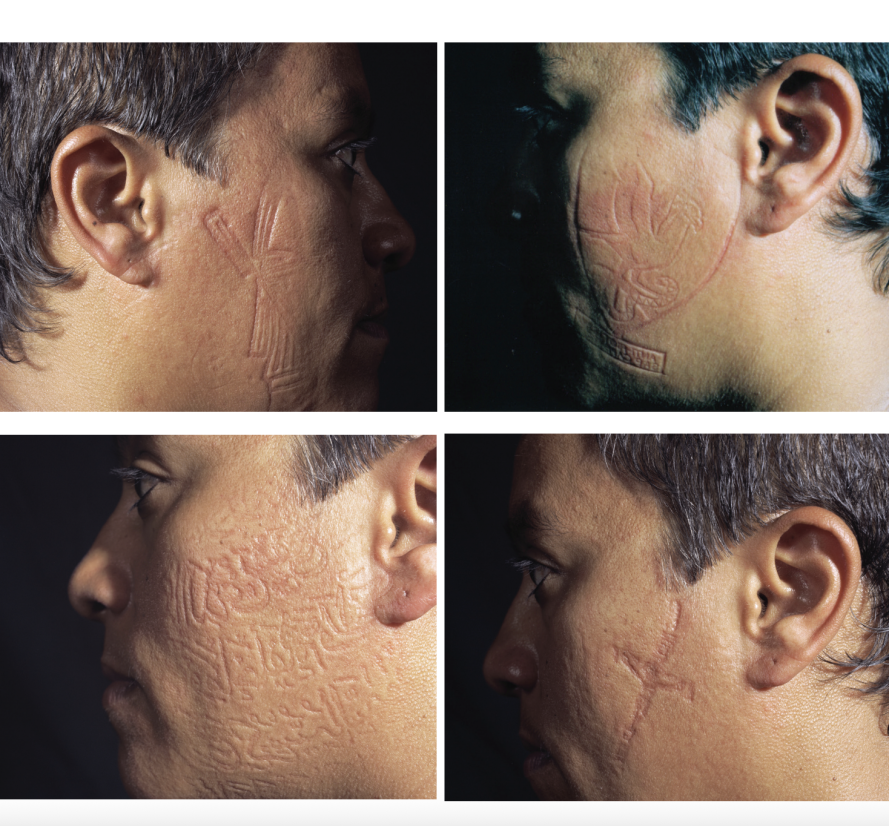
In Profile (2002), Berni Searle presses a cross, the British crown, a souvenir spoon, an anti-riot shield, a Zulu love letter, an Arabic prayer and cloves into her cheeks. Translucent photographs preserve these impressions on brown skin, making identity a record of contact with religion, trade, affection and state violence. Mariana Castillo Deball’s Forbidden Symmetries (2017) uses forty-five concrete paving stones from Berlin-Wedding, arranged through Roger Penrose’s non-repeating tiles and cast with hand-drawn engravings. The work interrupts pavement’s apparent neutrality with a pattern that cannot settle into repetition.
Daniel Butcher’s paintings assemble ancient imagery and speculative futures. Their torn and layered origins persist in figurative worlds that are recognizable without belonging to a stable time, inviting viewers into an unsettled visual dwelling. Maria Portilla’s inclusion keeps the chapter attentive to hosting as a practice shaped by artistic and social encounter. Wenxin Zheng transfers WeChat messages, travel photographs, selfies and everyday exchanges onto canvas. Images made for rapid circulation become a slower archive of contemporary Chinese social life, where inherited traditions and global media coexist.
Attar’s Valley of Doubt clarifies hospitality’s risk: a host cannot fully determine what a guest or cultural form will bring. Hosting concerns the material arrangements through which something can enter, remain and be passed on. The chapter asks how those arrangements might make a world inhabitable without mastering what they receive.

Ritualizing
Alanna Lawley, Dan Lie, Forough Alaei, Tawna
Alanna Lawley’s drawings approach matrilineal trauma through bodies that turn themselves inside out. Their appeal to female lineage and “natural wisdoms” also confronts a wellness economy that packages embodied knowledge as private self-repair. Dan Lie’s Secret Grieving Society relocates grief in transforming matter: hemp associated with Korean mourning, ceramics, branches, ropes and vessels altered by dye, sunlight, decay and reuse. Its finite lifespan lets loss act in the present without pretending to preserve it intact.
Forough Alaei photographs women in Iran repeating gestures that widen a restricted social field: entering prohibited spaces, gathering, dressing, moving and celebrating. Her “small seedlings” derive political force from persistence rather than immediate spectacle. Tawna, an anticolonial collective of Sápara, Kichwa and mestizo artists in the Ecuadorian Amazon, extends repetition into territory. Its films and collaborative projects draw on myths, dreams and embodied resistance while keeping narrative authority connected to the communities and lands from which it emerges. The forest participates in knowledge; memory is continuously re-authored.
Attar’s Valley of Loneliness describes experience severed from the relations able to carry it: privatized knowledge, individualized grief, isolated resistance, land reduced to resource. Ritual opposes this severance by making passages among bodies, generations, objects and territories. These works do not romanticize continuity. They show it being maintained, revised and materially borne. Soft power consequently shifts from circulating influence to sustaining the relations on which collective life depends.

Resonating
SoiL Thornton, Katja Pilipenko, Kalpesh Lathigra, Hashem Shakeri, Susana AbdulMajid
Resonance begins when relations travel through effects exceeding their source. SoiL Thornton’s Almost anything can be imagined, whatever you want, so imagine that, but not all can be painted and that's, well… (2021) examines systems that classify bodies, identities and objects. Neon green evokes a screen awaiting substitution; gendered colours, names and dress codes reveal conventions repeated until they resemble preference.
Katja Pilipenko’s In Search of Lost Security (2022) places continuous transcripts from Russian Channel One and Tagesschau, recorded before Russia’s invasion of Ukraine, on six suspended aluminium plates. Viewers move through competing narratives joined by the recurring language of security. Political communication becomes an environment whose urgency inhibits distance.
Kalpesh Lathigra negotiates visibility through sustained relationships with photographed communities. In The Lives We Dream In Passing (2026), he sees New Delhi through a taxi driver’s rear-view mirror, locating the image within the encounter that produced it. Hashem Shakeri’s The Kahur Does Not Fall Unless the Earth Wills It (2018–ongoing) connects drought, repression and memory in Balochistan. A scanning glitch bathes a man standing in a kahur tree in red; accident binds ecological endurance to the political moment of the 2022 Women, Life, Freedom uprising.
Susana AbdulMajid’s work across theatre, poetry and organizing gives transmission a social setting. With Anahita Sadighi, Poetry Nights Berlin brings Arabic and Persian poetry, music and audiences into a shared room. Resonance remains ambivalent: infrastructures carrying memory can distribute propaganda, and images can produce recognition or stereotype.

Becoming
Simon Speiser, Zeynep Boyan, Dieter Detzner, Anahita Sadighi
Becoming asks what culture can do as social infrastructure. Categories such as citizen, migrant, artist, woman or worker make people administratively legible; cultural practice may reproduce them or render them unstable.
Simon Speiser’s Cuerdas del Manglar (Strings from the Mangrove) continues the speculative documentary Naufragio Liberador (2024), considering shipwrecks in the formation of maroon communities in Esmeraldas, Ecuador. String theory and black holes connect disappearance to emergence, while scratch holograms engraved in metal evoke Afro-Ecuadorian memory and regional gold mining. Physics, colonial history, technology and ancestral practice meet without being collapsed into one system. Cultural survival appears as the production of forms from rupture.
Zeynep Boyan’s hand-built stoneware records pressure, resistance and support. Its negotiation of mass and void offers a model for relations sustained through adjustment: gatherings, rituals and languages endure by changing. Dieter Detzner turns this question toward architecture, where structures accumulate uses beyond their original function. Studios, schools, theatres, restaurants, clubs, streets and homes are not backdrops to culture but its material conditions; their disappearance removes a capacity to assemble.
Anahita Sadighi’s work as gallerist, curator and cultural producer creates encounters among ancient and contemporary art, Persian and Arab histories, literature and performance. It foregrounds the often-unseen labour that enables languages, histories and publics to meet. The amphorae she brings into the halls, from the Kashan region of central Persia embody the long tradition of Persian ceramic craftsmanship. Amphorae belong to the category of antique vessels historically used for storage and transport; these examples were used specifically for the preservation of dairy products, reflected in their bulbous bodies, narrow necks and symmetrically placed handles. The glaze colours and techniques characteristic of the Kashan region trace a tradition reaching back to the Elamite and Babylonian periods (1,000–2,000 BCE) and the Arsacid era (3rd century BCE – 3rd century CE). This archaic form and traditional method of production document centuries of development in Persian ceramics, joining practical function with historical heritage.
The exhibition thus relocates influence from the state’s desired image to the conditions in which people encounter one another and imagine themselves throughout history. Cities and institutions cannot credibly celebrate openness while displacing cultural workers, restricting migration or excluding the communities they represent. Soft Power Festival transits in this assertion as everything moves fast through the raging networks of global fascism.
//
References
Joseph S. Nye Jr., Bound to Lead: The Changing Nature of American Power (Basic Books, 1990); Nye, Soft Power: The Means to Success in World Politics (PublicAffairs, 2004). Nye’s distinction between coercion and attraction became a major framework for understanding cultural and diplomatic influence in the post-Cold War period.
Josh Kline, New York: Real Estate and the Ruin of American Art, and related writings and exhibitions, examine the relationship between real-estate speculation, cultural production, and the material infrastructures—land, property, labour and capital—on which it depends. Cover image: Berni Searle, Profile, 2002. Courtesy of the artist and PSM, BerliForough Alaei, The Glass Ceiling of Life, 2020. Courtesy of the artist