For almost two years, some of Serbia’s most significant theatrical practices have unfolded beyond theatre stages: in the streets and independent cultural spaces, we perform bare life, resistance, solidarity, defiance, radical trust and radical hope. From this experience, I want to shed light on the entanglements of theatre and the kitschy nationalistic, neoliberal authoritarianism we have been enduring. Its oppressive effects have not remained local, but have affected foreign theatre practitioners. Fortunately, solidarity in resistance has likewise refused the frame of Serbian borders and pushed us to consider disobedience that is not only diasporic, but simply cosmopolitan.
Being an independent cultural worker in Serbia in recent times has come close to being a suicidal undertaking. Artistic and cultural work rarely offers financial security, yet some of us willingly enter into this existential contract. Under authoritarian regimes, especially in periods of crisis, the cultural sector’s endemic precarity becomes a tool of political coercion. Artists and independent associations spend months preparing extensive applications for funding competitions, only to see their proposals rejected, competitions annulled without explanation, or funds channelled towards phantom organisations and mega-projects such as EXPO 2027. Moreover, politically compliant figures, often lacking the relevant qualifications, are appointed to head cultural institutions. Milena Dragićević Šešić, professor emerita at the University of Arts in Belgrade, argues that unlimited power breeds arrogance, which can escalate into repression and destroy thousands of artistic careers. The instrumentalisation of culture for ideological ends is not new; during the Cold War, the Belgrade International Theatre Festival (BITEF) also assumed a political role (cf. Vujanović, 2010). What distinguishes the present moment is the evident absence of intelligence and the prevalence of conformity in exchange for personal privileges. As producer, curator, and lecturer Marijana Cvetković observes, unfortunately, malpractice in the cultural sector goes unaccounted for until the system, i.e., the government, changes.
A telling example is Ljubiša Ristić, current artistic director of Atelje 212 Theatre, who once headed the Yugoslav United Left (JUL), effectively run by Slobodan Milošević’s wife. Ristić presented his new role as a rescue mission amid student and civic disobedience: “Everything is under threat: theatres, universities; who knows, tomorrow they may start abolishing institutions that do not function. We need to stop all of this and get back to working normally” (Danas, July 2026). This is institutional hypocrisy par excellence embodied in a man who still identifies as a leftist while co-opting emancipatory language to reproduce existing power structures.
In August, Ristić also organised a Shakespeare festival, while the original version established in Čortanovci in 2014 was cancelled due to the deliberate lack of state support. That is how I ended up attending a “politically correct” festival showing Padežanin’s The Merchant of Venice, relocated to 1938, when fascist Italy introduced its racial laws. Particular emphasis was placed on Shylock’s declaration: “The villainy you teach me, I will execute, and it shall go hard but I will better the instruction,” and the piece ends with a bold statement equating conversion to Christianity with becoming a fascist, accompanied by the well-known hand gesture. Padežanin’s reference to Palestine was certainly courageous, but his questioning of the right to moralise was painfully narrow since the audience was not compelled to confront the state-induced erosion of morality in our local conditio humana as Serbia exports weapons to and co-produces drones for Israel. Drawing on Sontag’s Regarding the Pain of Others, we could have observed and even consumed others’ struggles and suffering and moralised about it while local (theatrical) injustices remain unnamed. The irony was too precise: a couple of weeks later, this production inaugurated BITEF 59 at Atelje 212! The regime staged normalcy without taking accountability for the censorship and subsequent cancellation of the previous edition, presenting the festival as evidence of exemplary messianic cultural policy.
Meanwhile, all invited international companies from Italy, Portugal, Argentina, Lebanon, Germany/UK, Slovenia and Montenegro withdrew in solidarity with Serbian colleagues resisting censorship and authoritarianism. The sole holdout was Belgrade Drama Theatre (BDP), whose regime-aligned board disregarded director Oliver Frljić’s objection. This collective withdrawal was a significant act of transnational theatrical solidarity. In this context, and with all due respect to the withdrawn companies, their absence was not necessarily a theatrical loss, nor did it make the ideologically re-curated BITEF 59 (under the slogan Dare to Know) any more necessary. The funds could have been put to better use (e.g., supporting the independent scene). The newly appointed artistic director handpicked theatres from Bulgaria, Russia, Moldova, Georgia, Turkey, and Tunisia. I would interpret this approach as a form of counter-activism: the regime reoriented the Festival towards theatrical voices beyond the Global North, not to broaden the aesthetic and political horizons of subaltern theatres, but to instrumentalise these voices in service of its own political agenda, turning BITEF into a festival of opportunistic theatres. In contrast, NE:BITEF, the counter-festival, the only true BITEF, imagined, for the second time, alternatives to the structures it resists. It was led by those who have shaped the festival for years, even decades, under the motto “BITEF is wherever we gather”, epitomising Ahmed’s (2021) argument that disrupting abuses of power requires new forms of collectives.
As a nomadic subject, continuing to inhabit the space in between even in my country of origin, I can benefit from this unstable position by attending both the official festival and the counter-festival NE:BITEF. While my presence at the official festival produced an aesthetic and ethical unease, my participation in NE:BITEF was both a moral need and a personal desire to help prove that power can capture institutions, but not the people who give them meaning. I went to three performances at BITEF 59, leaving two halfway through. Frljić’s piece was cancelled a few hours before curtain-up due to health issues, so the vulnerable body (cf. Butler et al., 2016), subjected to control and discipline, became itself a locus of subversion. When I asked how they felt about participating as a plan B at such a socio-politically charged festival, two Moldovan performers expressed absolute delight, totally unaware of the broader situation. Such a lack of curiosity raised questions about the responsibility of artists participating in politically compromised institutions and the consequences of promoting content of questionable artistic value at an international platform for renowned contemporary theatre. The auditoriums were mostly half-empty (we usually fight for a seat at BITEF), reinforcing the impression of a regional theatre showcase. A festival dedicated to presenting new theatrical tendencies since its inception has become an exercise in institutional self-destruction, undermining its reputation while being deeply entrenched in the state-organised production of hate (cf. Ahmed, 2004).
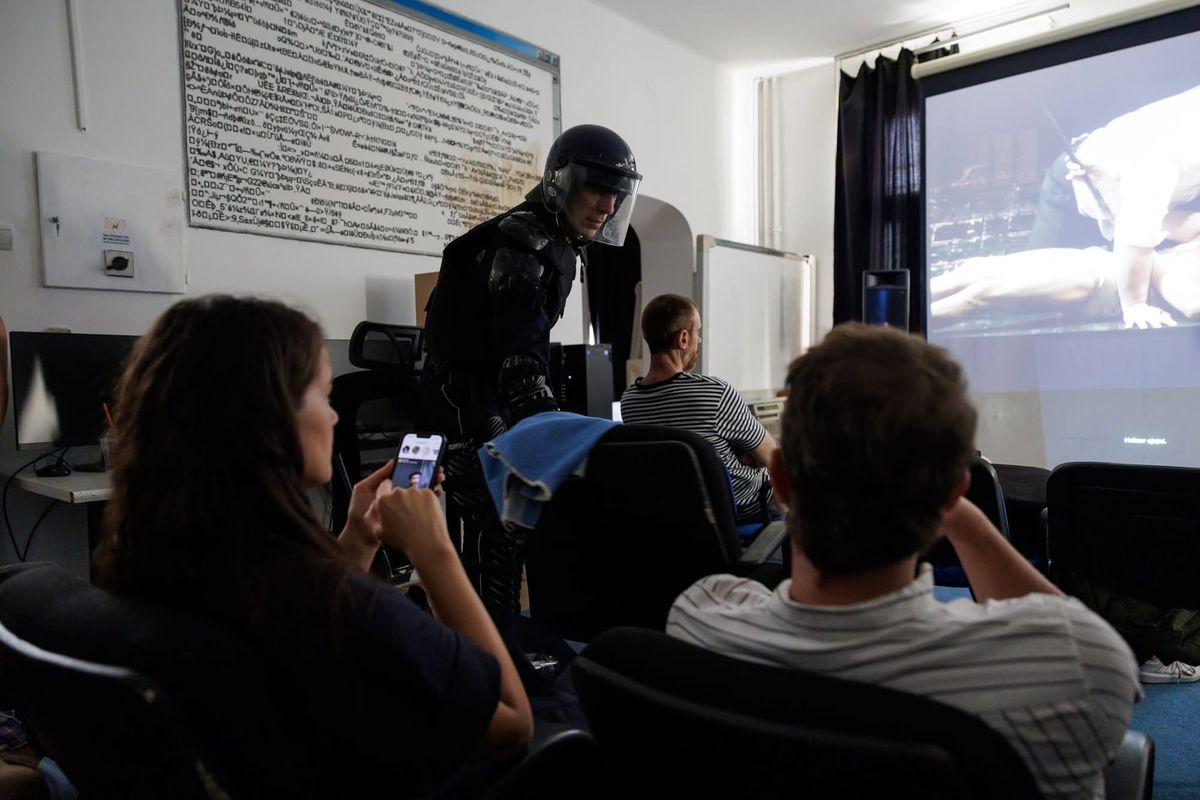
NE:BITEF took place on 20 September, the final day of the official festival, conceptualised as a horizontally organised festival of 60 micro-scenes (in homage to BITEF’s 60th anniversary), spread across the city between noon and 6 p.m., free of charge. Each scene was curated by an artist or cultural worker nominated by the cultural community itself, and dedicated to a work or figure that had shaped BITEF’s history. Among the participants of NE:BITEF were the disobedient withdrawing companies Motus and Gob Squad, then Pussy Riot, Thomas Ostermeier, Anja Suša, Milo Rau, Ana Vujanović, and others. In this instance, I will refrain from discussing the programme, since what mattered was the act itself: a self-organised, collective, liberatory and partly hybrid practice of civil disobedience and creativity, echoing the leaderless student movement in which no one takes precedence over anyone else. It demonstrated that theatre can keep the spirit of revolt alive, and that artists are no longer confined to inner exile. Instead, they are forging enclaves of solidarity and dissent that are as precarious as they are dangerous to the established order. The independent (free) scene is both free and freeing precisely because it critically questions its own organisational structures and modes of action. As Foucault (1983) puts it, “power is exercised only over free subjects, and only insofar as they are free.”
Nevertheless, BITEF must not retreat entirely into discourse. I hoped for one performance, for just a bit of performativity on an actual stage. The most frequently cited objection was the cost. Excuse me?! I have seen extraordinary theatre in Buenos Aires made with literally no budget. Have we become so accustomed to the resources and infrastructures we have that we can no longer dare to create otherwise? Are we not all rather spoiled already, and some of us so deeply entrenched in privileges that we refuse to expose ourselves to any form of personal deprivation in the practice of (transnational) solidarity? Solidarity cannot remain within language and symbolic gestures. It must also entail the redistribution of resources. The Club Commission in Berlin, for instance, has advocated “to make more with the money we have through collaboration.” Could transnational solidarity mean sharing production budgets, fees, technical infrastructures, rehearsal spaces and institutional platforms? A sort of multilayered relinquishing of privileges, enacted in alternating turns which would make solidarity less comfortable, but considerably more consequential and disruptive. At the end of the day, it is all a question of class.
One omission, however, deserves attention. Given NE:BITEF’s commitment to solidarity and emerging theatrical tendencies, I would have expected some recognition of Radionica, an independent cultural space run by Russian émigrés, that has welcomed local artists and actively engaged with Belgrade’s performance and art scenes, bringing a rare performative liveness and sense of otherness. Acknowledging Radionica would have extended solidarity into the local performance ecology. A festival committed to the commons and horizontality must also ask whom it makes visible and whose presence and competencies remain marginalised/excluded.
Lastly, I would like to see the reverberations of NE:BITEF travel beyond Serbia, hoping that the artists and companies who participated and those who withdrew from BITEF 59 will continue to speak about these possibilities, enabling solidarity’s survival beyond the moment of moral legibility and friendships in need. The task is to build the material conditions under which such resistance can continue. Otherwise, even the most radical gesture risks becoming another emancipatory proposition we admire and then leave behind.
The struggle over BITEF offers a micro-perspective on the general struggle that was unfolding in Serbia, where students and their allies have managed to translate collective resistance into a viable political option named The Students’ List under the slogan "Students Are Winning". And STUDENTS WON the elections on 25 October! WE WON! Such success demonstrated the potential of solidarity as a sustainable political force, proving that disobedient citizens, despite lacking financial resources and infrastructure, are by no means lacking in creativity. What we sometimes lack is trust in ourselves, in one another, and in our collective imagination as the agency of change. This is why we need global networks of resistance, alliances among people defending land, life, dignity, and the possibility of democracy. Our struggles do not need to be identical for our solidarity to be real and disruptive.
//