
Common Skies
Where it Starts
Aby Warburg was born affluent. Let’s start there. A banker’s son with a fetish for Botticelli and Babylon, he turned his back on the family business. He literally gave his inheritance away, on the condition that the family buy him any book he wanted, and then he went full iconomaniac.
He wasn’t poor, materially, but spiritually? That’s another story. He swapped capital for cosmology [1], became less Renaissance man than visual necromancer. The kind of guy who talks to demons in the desert and diagrams their gestures with string and pins.
His famous Mnemosyne Atlas—a grid of black panels littered with images torn from postcards, newspapers, Renaissance prints, depictions of pagan rituals, astrological diagrams—has been misread for decades as a proto-Google Image search or, worse, the first known moodboard. But that’s sloppy. Warburg wasn’t anticipating the dominance of the algorithm. He was processing it by looking for meaning in the afterlife of images.
Warburg wasn’t interested in celestial imagery, astrology, and cosmology in order to glorify the heavens. He mapped them because he was terrified. Terrified of what images do to us, what symbols can carry, what returns under different names. He wasn’t an art historian; he was an exile in his mind. The Atlas was not about art history. It was about psychic survival.
The Sky Was Never Neutral
This summer, in Hamburg, almost a century later, Warburg’s legacy flickers back into view—not in a typical museum, but out in the open: a public park, a former water tower turned planetarium, and the Warburg-Haus. It’s not a revival, it’s Nachleben—his word for that which won’t stay buried. Images, gestures, systems of thought: they return, not to comfort us, but to complicate the present. Warburg knew the past never ends cleanly. The past is a point of one of its re-entries.
The reinstallation of Warburg’s 1929 exhibition Image Collection on the History of Astrology and Astronomy forms the gravitational core of From the Cosmos to the Commons, curated by Joanna Warsza, the newly appointed city curator of Hamburg. Warburg’s 1929 exhibition, originally assembled in the final months of the scholar’s life, and realized in collaboration with Gertrud Bing and Fritz Saxl, has slipped into obscurity—its contents presumed to be lost until their unexpected rediscovery under a pile of discarded materials in the late 1980s. The art historian Uwe Fleckner, who found them, now oversees the exhibition’s meticulous reconstruction.
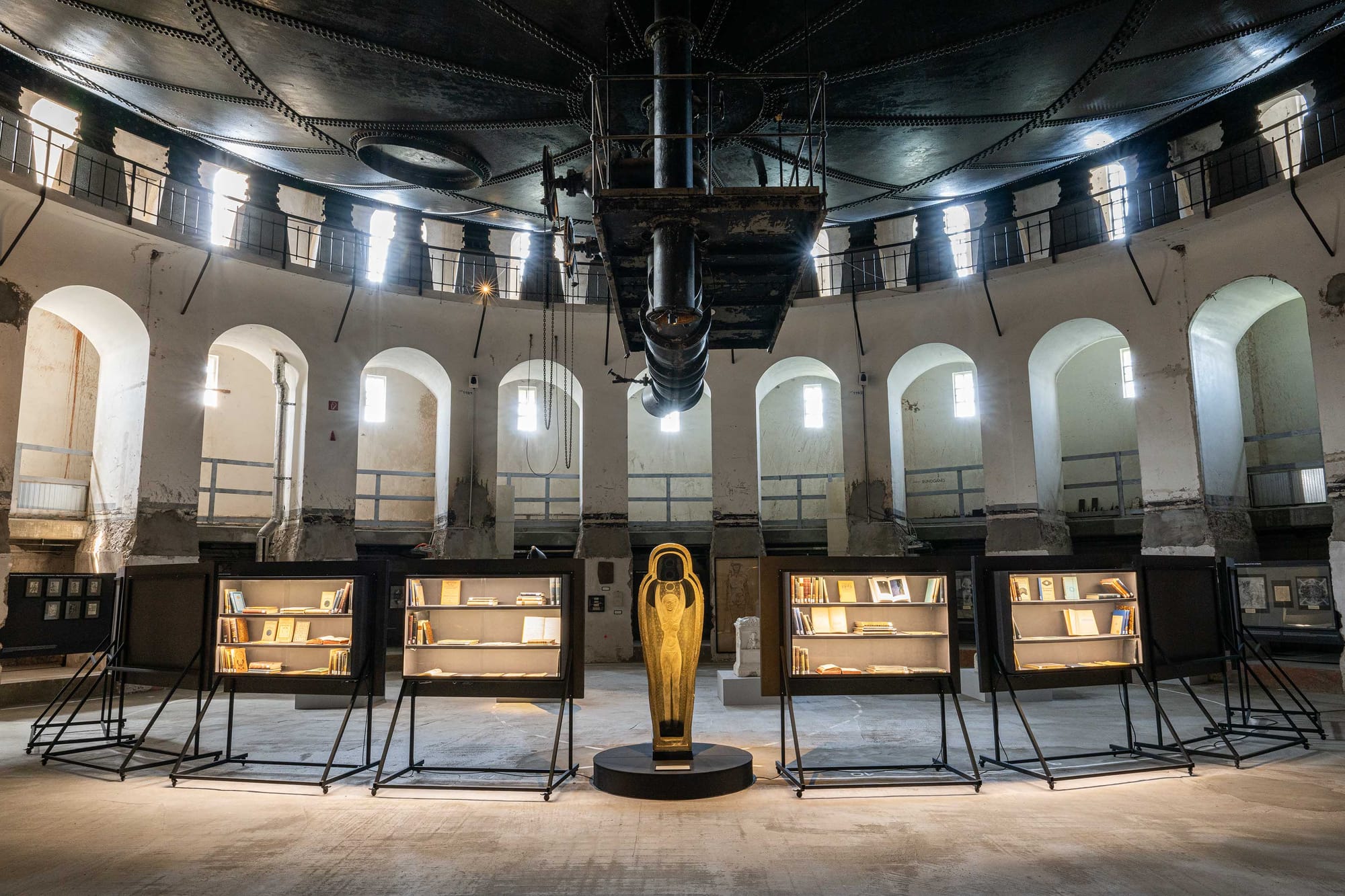
Fig. 1
In his elliptical [2] visual grammar, Warburg articulated his belief that images have orbits like planets, that symbols migrate across time and culture, and that the past never stays still. This exhibition doesn’t seek to contain or decode Warburg. It doesn’t offer a tidy narrative. Instead, it moves with him, and from him—drawing eccentric rather than conclusions.
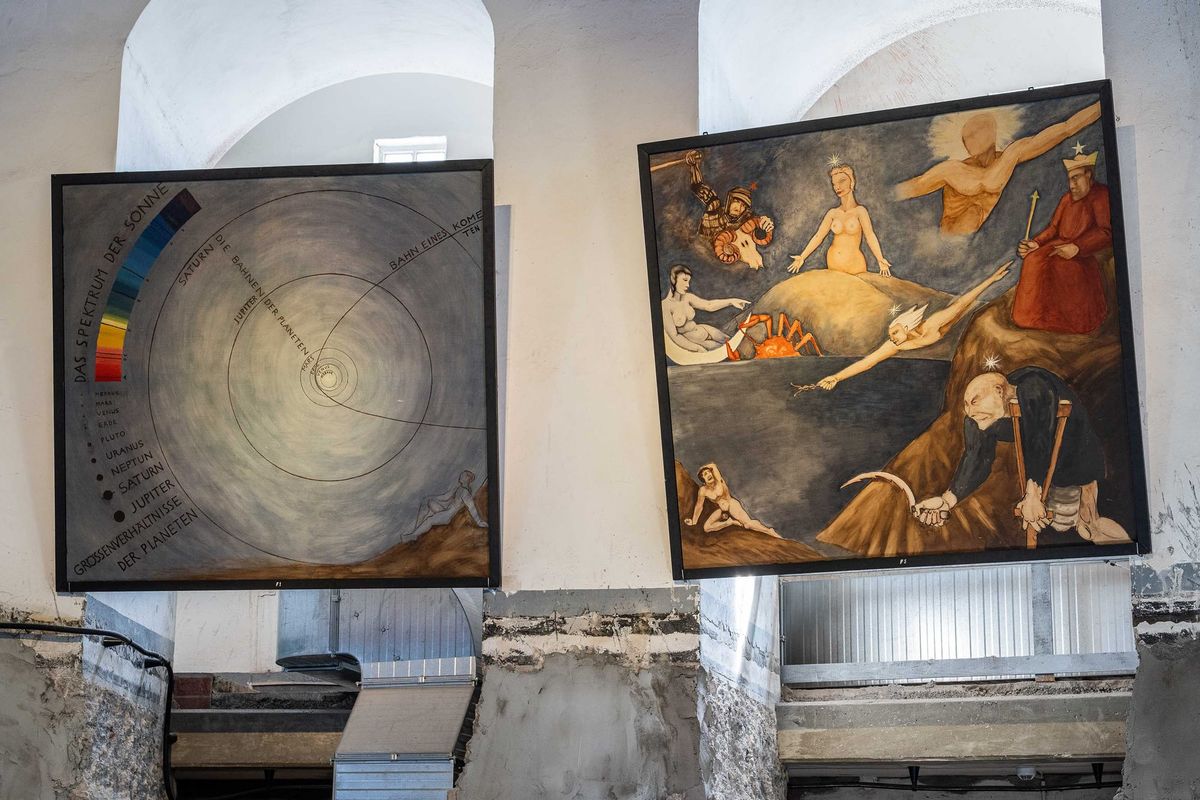
The project’s point of departure is the rediscovered exhibition, first shown in 1929 at the Hamburg Planetarium. The same dome now hosts a careful reconstruction of Warburg’s final work—there is the constellation of black-framed panels, filled with diagrams, planetary symbols, mythic forms, and gestures that seem to repeat across millennia. They are categorized; each panel corresponds to a theme: Babylonia, Egypt's antiquity, Greece, the Greco-Roman world in late antiquity, Luther and astrology, Kepler, etc. As with his better-known Mnemosyne Atlas, the goal is not accurate chronology, but rhythm. What matters is not when an image appears, but how it reappears.
Though there’s something uncanny about it—distant, even, as it draws on pathos formulas (Pathosformeln), i.e., emotive visual tropes that carry intense psychological and cultural meaning across history, here, they seem to embody a kind of celestial longing. Warburg’s thinking was rooted in Western hierarchies—elevating classical antiquity as the cradle of culture while viewing non-Western symbols through a European lens. Yet he also exposed cracks in the West’s self-image, showing how myth, emotion, and the “irrational” persist beneath modernity’s polished surface. From where we stand in 2025, his framework feels detached—tied to a Eurocentric cosmos that ignores the lived realities, resistances, and cosmologies of the majority world.
That cultural standards shift over a century is quietly acknowledged by the disclaimer posted on the wall of this “forgotten” exhibition. Comprising historical materials that trace how humans across cultures have looked to the sky to locate themselves on Earth, the proposition invites a layered reading. Warburg insisted that images move through time—carrying with them meaning, resonance, and symbolic weight. Not all survive unscathed. Several depictions on view sit uneasily within contemporary frameworks of inclusivity, respect, and cross-cultural understanding, and may be perceived as offensive. Rather than erasing these images, the exhibition invites critical engagement—an encounter with the ideological residues history leaves behind, not a longing for their return.
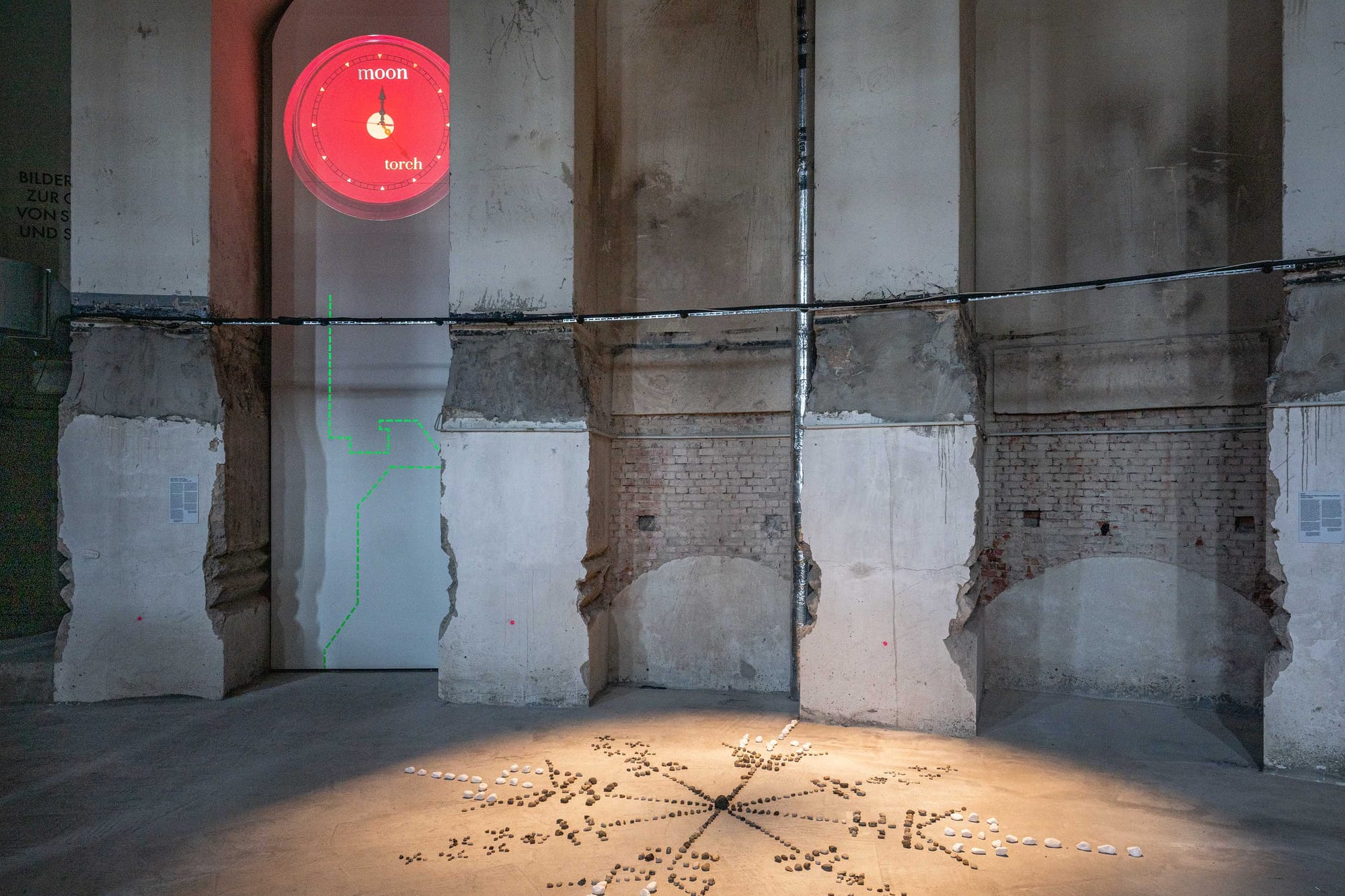
Fig. 2
Suspended and slightly inclined above the panels is a striking diptych by Warburg’s son, Max Adolph Warburg: Man Torn Between Scientific Analysis and His Fear of the Supernatural (1929). The painting asserts its presence amid a surrounding cosmos of humanoid figures and planetary forms, positioning itself at the uneasy intersection of interior conflict and celestial immensity.
Gazing down at the viewer, the diptych functions less as a form of resolution than as a warning—a sobering reminder of our smallness in the face of systems we can only ever partially comprehend. These are structures that evoke both awe and unease, awakening fears that rational inquiry alone cannot contain. At the same time, the work endures as a quiet testament to perseverance: a fragment of personal and historical cosmology that continues to resonate nearly a century on.
Elsewhere in this micro-cosmos, a sarcophagus stands facing the entrance of the space—its presence unmistakable, a stark memento mori embedded in the exhibition’s celestial drift. Confronting the viewer not with transcendence but with finitude, it anchors the cosmic in the corporeal, the symbolic in the skeletal.
Circling the elliptical grammar of Warburg’s mise-en-scène are four contemporary interventions: by KITE, María Edwards, Raqs Media Collective, and Eske Schlüters. This could be understood as casting a temporary shadow over the historical image. Not an erasure. Not a tribute. Something more unstable, more alive: an eclipse? Each work breaks the orbit, posing questions Warburg didn’t live long enough to ask—about indigenous cosmologies, colonial time structures, and language as a way of mapping planets and power.
Asteroids of the Stadtpark
The Nachleben, as it unfolds through the contemporary contributions, continues to oscillate between the pictorial-mythical and the symbolic-mathematical.
On the façade of the Planetarium—symmetrical, facing the park and fountain—hang textiles by Polish-Roma artist Małgorzata Mirga-Tas. Her Herstories (2022-ongoing) series maps a personal zodiac of resistance: Timea Junghaus, Ceija Stojka, Esma Redžepova, Grażyna Mirga, Soraya Post. Not just portraits, but presences—stitched into public space, sewn with what Ethel Brooks calls a “feminism of the minority”, they are embodied, local, and unafraid of power. Mirga-Tas, in ongoing dialogue with Warsza—her collaborator in Venice in 2022 [3]—looks to the zodiac belt of Palazzo Schifanoia, where gods, months, and signs once cycled among each other in a fresco. Warburg saw them as Bilderfahrzeuge—images in motion, carriers of meaning. Here, that belt is rethreaded. Roma visibility, feminist memory, and celestial signs are woven into a living cosmology—born not from conquest, but from survival.
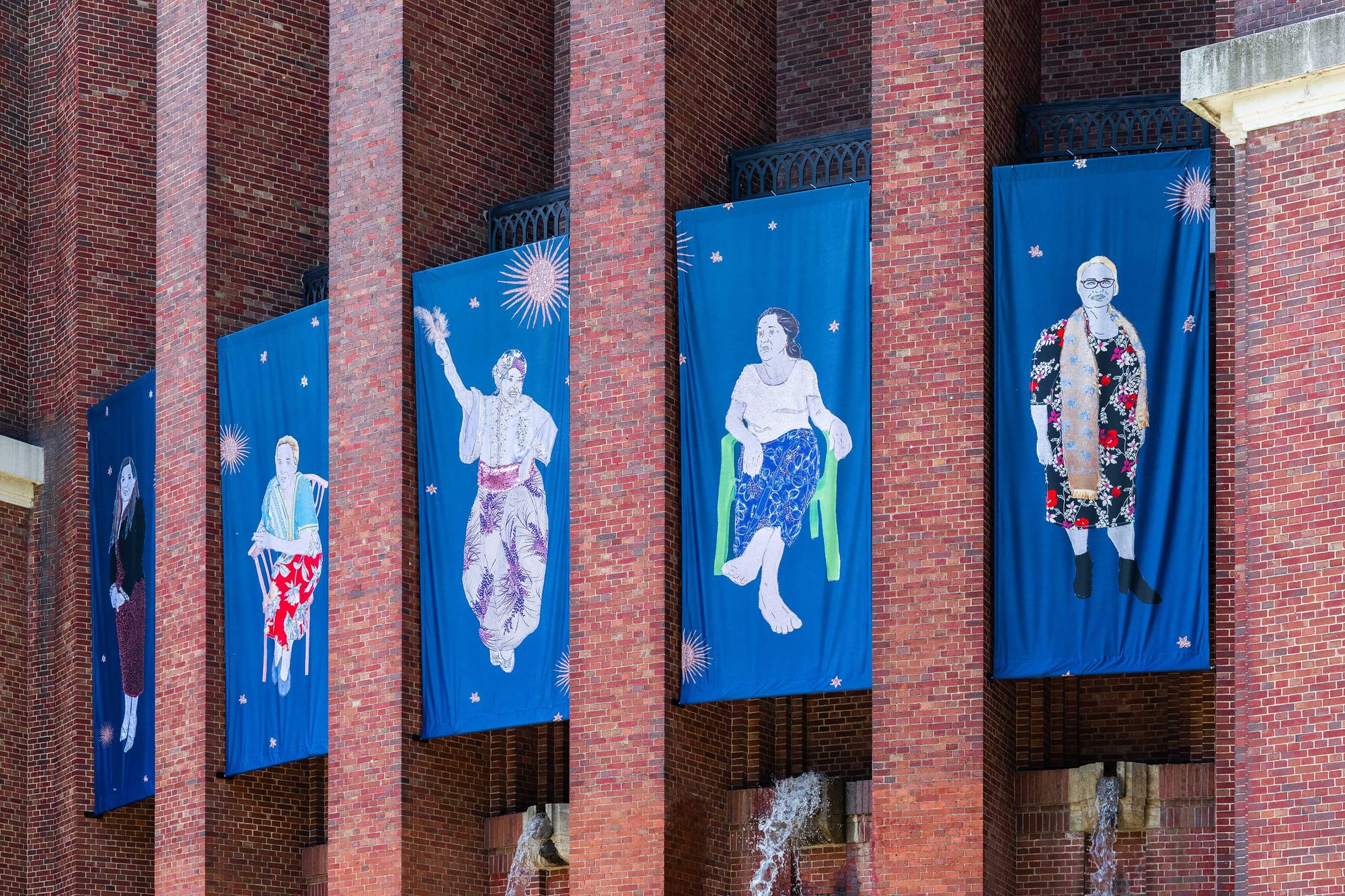
Fig. 3
This isn’t a Renaissance revival, however. It’s resistance in fabric. An alternative constellation hung in the open.
Timo Nasseri’s Unknown Letters (2015-2025) starts from absence—four lost characters imagined by the 10th-century calligrapher Ibn Muqla that were erased before they could take form. What remains is Muqla’s grid of rhomboid dots, a system still used to shape Arabic script. Nasseri revives what history discarded, not to restore, but to reimagine and reposition. In the monumental niches of the Planetarium, he sculpts possible futures for these phantom letters that are precise, abstract, unresolved. Drawing on Islamic astronomy, he transforms forgotten knowledge into public form, questioning who decides what survives and what disappears.
Beyond the Planetarium, the exhibition spills into Stadtpark, where public installations form a kind of commons-oriented constellation. No plinths, no fences, just art that breathes the same air as joggers, kids, and dogs. Those present at the opening—or participating in one of the guided tours—are invited into a carefully orchestrated micro-cosmic narrative led by Warsza in the role of steward—not of air or aisle, but of atmosphere and attention. She tends the passage from the metaphysical to the material, from the mythic to the mutual. For others, a more solitary path unfolds: wandering through the park, one may stumble upon an artistic intervention tucked quietly into the landscape, waiting to be discovered and activated rather than announced.
Inspired by Isamu Noguchi’s Sculpture to Be Seen from Mars (2025)—a post-Hiroshima gesture meant not for those living now, but for whoever (or whatever) comes after—Sibylle Peters and Felix Jung grow a living face into the earth. Not for people. Not for now. It can’t be seen from the ground, only from the Planetarium, from above, from elsewhere. From a time when maybe we’ll be gone. A face as a message, as a marker, as a reminder that we tried. That we knew. That we couldn’t stop. It holds grief and care in the same shape. It looks back at us from a future we can’t reach.
Down below, Shahira Issa moves in the opposite direction. Time Hid in the Sun doesn’t want to be seen at all. It disappears into the forest. No screens, no signals. Just air, leaves, breath, and voices barely louder than the wind. If Peters and Jung send a message skyward, Issa turns inward, downward. Two works move in opposite directions. One monumental, one almost vanished, one asking how we’ll be remembered.
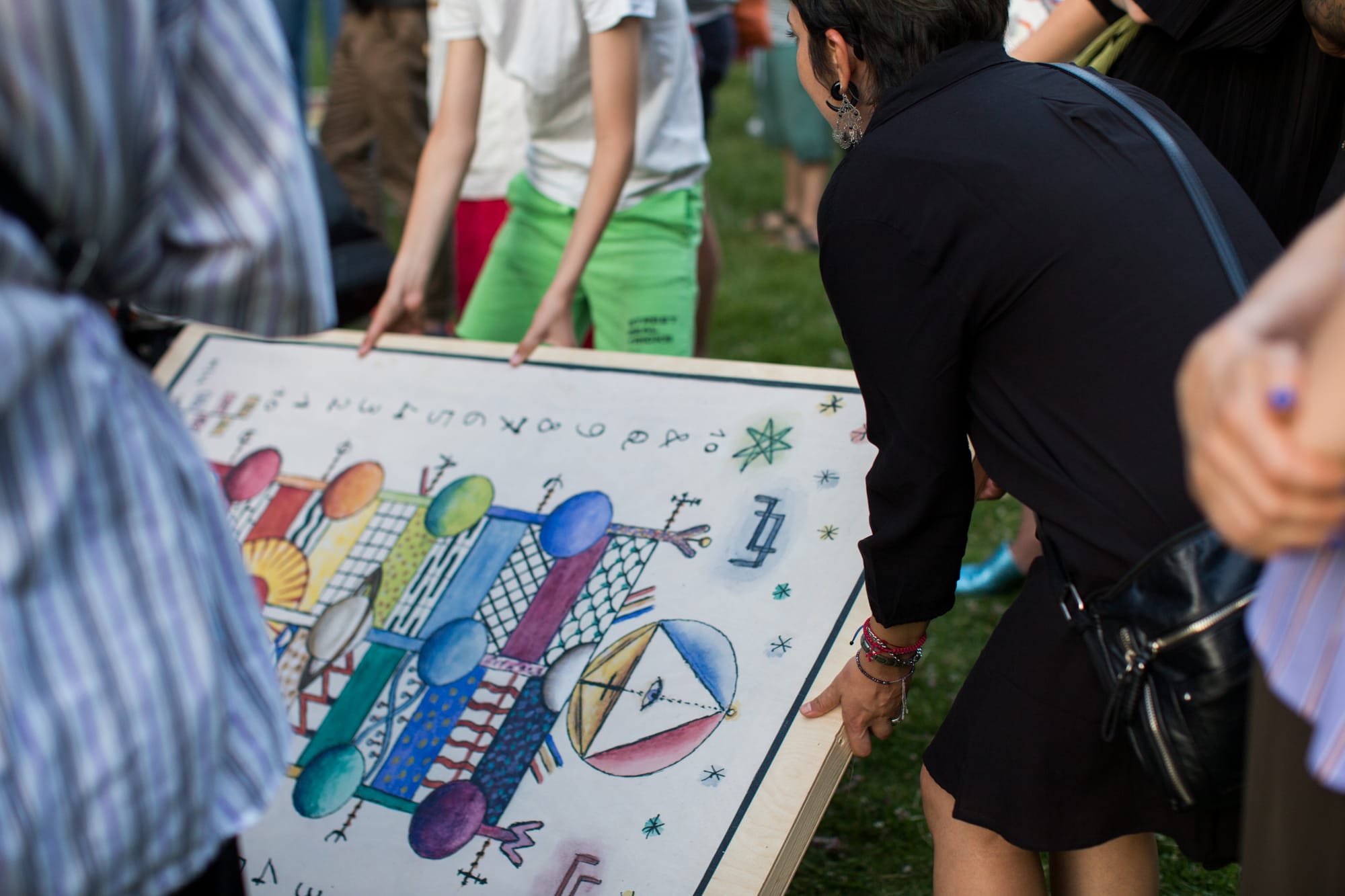
Fig. 4
In Hamburg’s Stadtpark, the stars come down to walk among us. The Argentine artist and astrologer Xul Solar, who once passed through the city in 1924, returns in fragments. His oversized cards from the Tarot Deck (1953/1954)—each one bearing a zodiac sign—appear on select days like loose divinations scattered through public space. No monuments, no permanence. Just moments of alignment: you, the sky, a sign, then it’s gone.
Nearby, Agnes Denes’s Sunflower Fields (2021/2025) stands its ground. A work planted and replanted across cities—from Basel to Pristina and now here—it leans toward the sun with quiet insistence, a heliocentric manifesto made of seeds and soil. Slow, steady, unyielding. One work moves, the other grows. Both resist enclosure. They offer no grand revelations—just reminders that we live under the same sky, still looking for signs, still turning toward the light. Keep going, and you may come to realize how the cosmos exhales through compost, finds shelter under fabric, and settles on benches shaped from felled trees and sedimented memory.
Hoda Tawakol’s Cosmic Womb (2025) turns to Nut, the Egyptian goddess who swallows the sun each night and births it each morning. But Nut here is not a distant myth—she arches gently across the grass in a padded, star-strewn canopy, soft and cosmic, a structure shaped by breath and gravity. A shelter for resting, reflecting, and remembering the maternal as force, not role. Feminized labour made visible, spatial, and public.
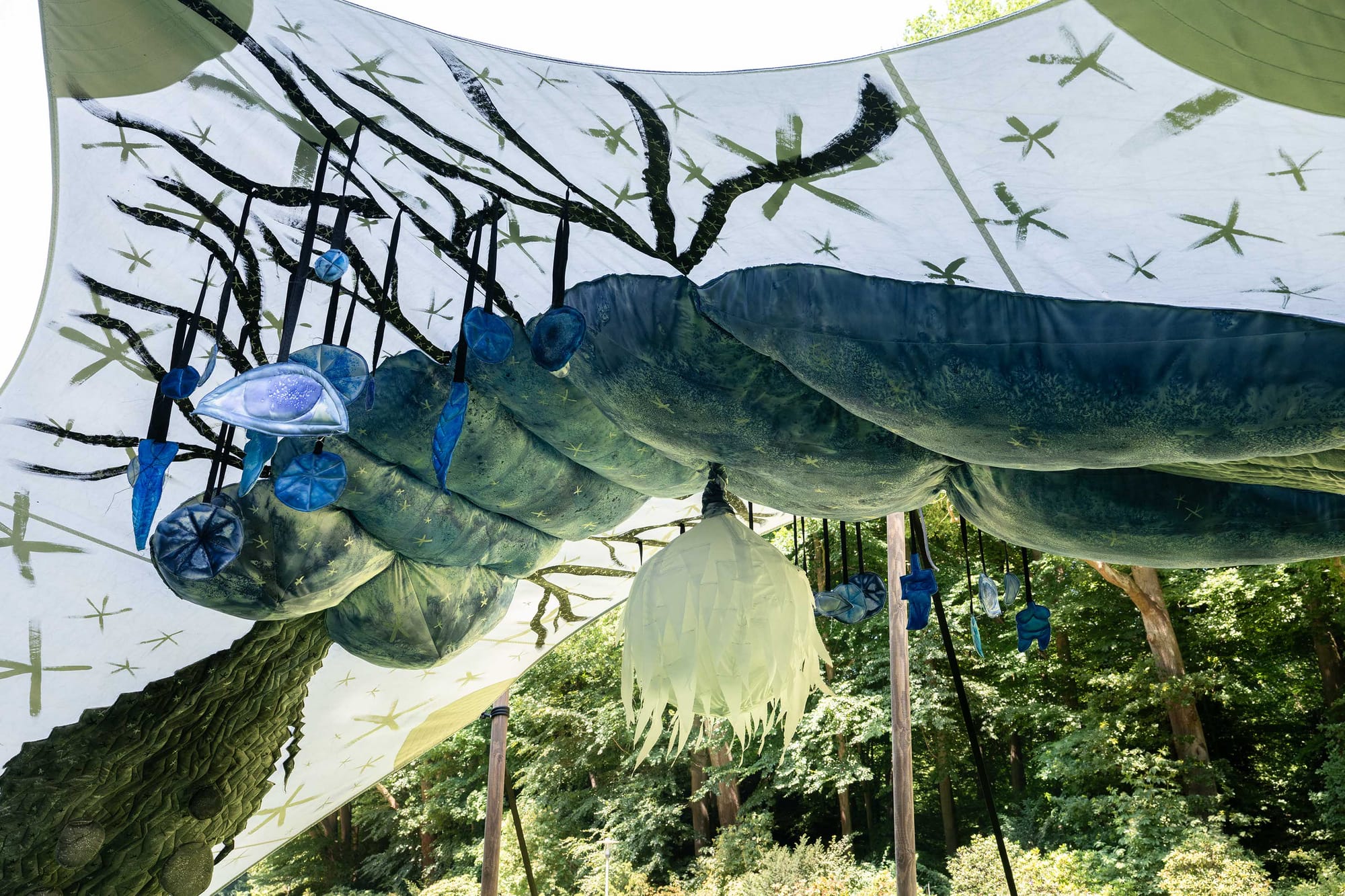
Fig. 5
Not far off, Ben Nurgenç’s From the Cosmos to the Compost (2025) drifts through the park, pulling a homemade bio-reactor like a strange companion. It turns detritus into energy, compost into current— enough to power a radio tuned to the background hum of the stars: cosmic listening, built from scraps. Call it a new genre, one that’s been composting quietly in the art world for a while now, techno-ecology with dirt under its nails. A reminder that decay isn’t the end of a system—it is the system. The forest floor has always been talking to the sky. We just forgot how to listen.
And then there’s Olu Ogunnaike’s A Good Neighbour? (2025), a series of benches and one elliptical table, part ellipse, part gathering point. Made from trees grown and fallen here in the park, mixed with wood species from across the globe, Ogunnaike’s work refuses borders. Inspired by Warburg’s logic of proximity, the furniture stages a kind of slow pedagogy: to sit here is to learn through adjacency, through texture and time. The elliptical bench evokes return—shadows and crossings, trees that endured long enough to become a place of gathering. Warburg’s ellipse was never just a shape. It is a form of knowledge that orbits; it does not have straight lines. It expresses a refusal of progress as a straight road.
This is a project that takes that form seriously—spiraling instead of marching, orbiting instead of landing. From this nonlinear logic, the works expand.
Salwa Aleryani’s Shadows Cast (2025) and Heidi Voet’s Hydra & the Orange Giant (2025) bring the sky down soft and low—making time and myth pulse through your body and under your feet. Aleryani’s sundial is activated by a human participant whose presence creates a shadow that then indicates the time by scattering light and shadow among the green tiles, inviting the visitor to step into the sun’s rhythm. Voet’s stars rest in a circular amphitheater, cast from worn-out sports balls [4], tracing and mirroring Hydra—the longest constellation—which is just barely visible above Hamburg’s smog and seasonal sky. Hydra drifts low on the horizon, almost out of sight, but here it is solid in concrete, and faded from play, folded into the commons. It’s a beautiful mutualism, a quiet claim of cosmic scale.
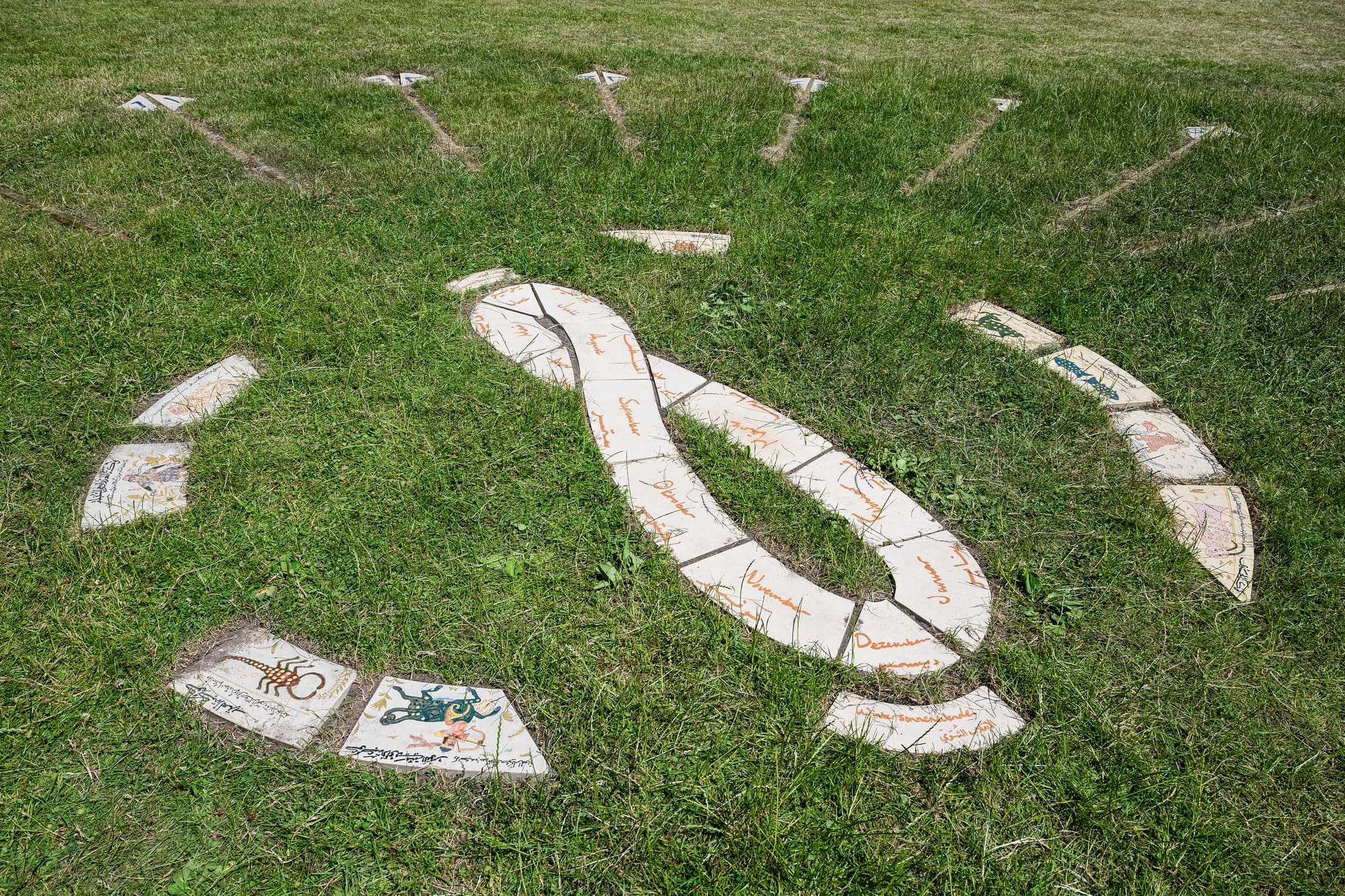
Fig. 6
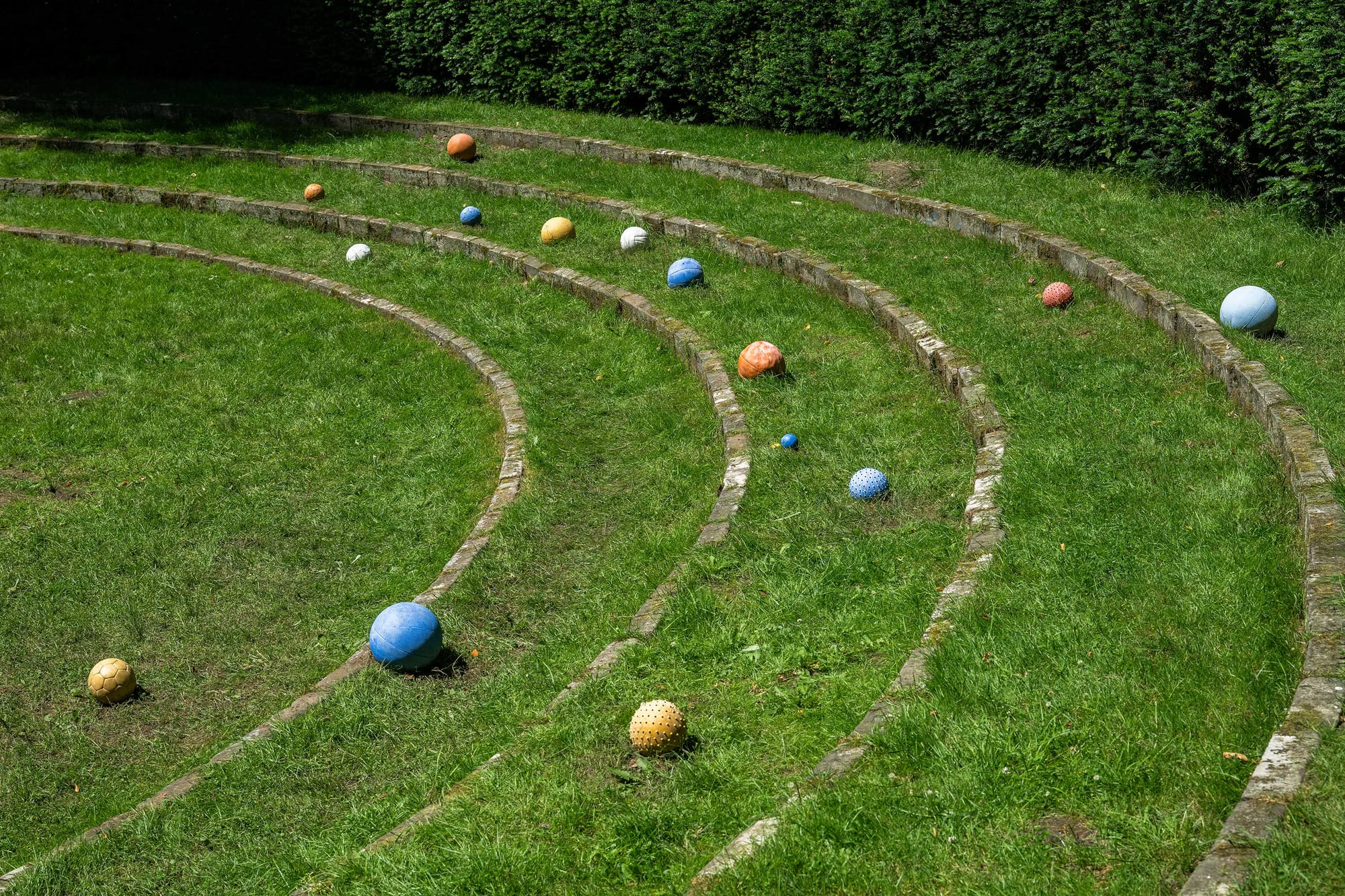
Fig. 7
This version of the constellation is gentle, free from the grit of struggle or conflict. Life here moves with ease, shaped by weather and the occasional vandal’s mark, not by protest or resistance. No fences, no rules—just a soft invitation to sit, stand, or look up and wonder.
Ellipses recur—in the shape of tiles, bodies, and stars—reminding us of how time curves, folds, and loops instead of simply marching forward. The materials hold traces: sun-warmed stone, faded concrete, and stretched fabric. Embedded in the work is knowledge that is often pushed aside—Islamic astronomy, African cosmologies, matriarchal science. These traditions feature not as decoration, but as tools to orient, to remember, to belong.
Together, these works turn the park into a commons, where myth, memory, and motion move through the everyday. But it’s a calm commons—one that asks for presence, not confrontation; connection, not clash. A universe revealed slowly, in ease and orbit, but missing the sharp edges of conflict that often shape our shared world.
In public space, art is never alone. It contends with the everyday: the bounce of footballs, the smoke of barbecues, laughter, music, the rituals of leisure and life. It’s not about dominance, but coexistence—inserting propositions into spaces already full of meaning.
The Ellipse Never Settles
Not a flashy blockbuster shouting for a planetary crowd, From the Cosmos to the Commons moves slowly, moves sideways. Images don’t sit still—they orbit. Artworks pull like gravity, but there’s no center to cling to. Just a restless, quiet tug.
The exhibition refuses “now”. It doesn’t run toward crisis; it simply looks the other way. It oscillates, like a tarot reading without easy answers, like Warburg’s ellipse circling between two poles—never closing the loop, just feeling the weight of history, the pull of myth.
No spectacle. No rush. Just signs unfolding slowly—old, borrowed, alive. Not a future made clear, but a way to read the present differently. When everything wants you to be sharp, here’s space to soften.
Warsza might be reaching for that “planetary public sphere” — a call for respect, care, and something shared, but humans are messy. Conflict isn’t a glitch; it’s the system. The cosmos is full of black holes, swallowing light. Still, maybe imagining differently is worth the fight.
So, Who Owns the Sky?
Warburg knew that images survive fascism.
He knew that myths don’t die; they mutate.
This project honors the anxiety that mutating myths stir—not with nostalgia, but with defiance.
In 2025, under surveillance satellites and climate collapse, Warburg’s images still orbit.
Through Warsza’s curation, they do so in the open air.
Among sunflowers, mushrooms, and shadows.
Among strangers.
Who said the sky was ever neutral? It’s been charted, divided, named, and claimed. And still, it belongs to all of us—or none of us at all.
//
The exhibition From the Cosmos to the Commons will be running until 24.08.2025. Find more info here.
Footnotes
[1] Particularly, how they appeared and were interpreted in art, culture, and mythology across different periods.
[2] Warburg ripped open the perfect circle and found Kepler’s ellipse inside—a shape that didn’t close neatly but stretched between two points, pulling and pushing, never resting. It’s no neat orbit; it’s tension, conflict, movement—exactly what Warburg saw in history and images, caught between myth and reason, past and present. He didn’t just think it—he built it: the Kulturwissenschaftliche Bibliothek’s reading room is an ellipse, a space that holds that restless push and pull, a room shaped by struggle, not harmony.
[3] Maria Lind, ‘Malgorzata Mirga-Tas and Joanna Warsza on the Polish Pavilion in Venice,’ Ocula Magazine, 10 August 2022, https://ocula.com/magazine/conversations/magorzata-mirga-tas-in-venice/
[4] The colors of the balls relate to the Morgan-Keenan Classification System for stars according to their age and temperature. The orange giant, Alphard, for example, is the largest star in the Hydra constellation at 177 light-years away from Earth.
Images:
Cover: Image Collection on the History of Astronomy and Astrology - Aby Warburg in Collaboration with Gertrud Bing and Fritz Saxl, Planetarium Hamburg, 2025 © Foto Maik Gräf
Fig.1 Image Collection on the History of Astronomy and Astrology - Aby Warburg in Collaboration with Gertrud Bing and Fritz Saxl, Planetarium Hamburg, 2025 © Foto Maik Gräf
Fig.2 On the left: Raqs Media Collective, A Day in the Life of Kiribati, 2014 & Blood Moon,2024/25; on the right: KITE, Iktómiwiŋ (A Vision of Standing Cloud), Planetarium Hamburg, 2025 © Foto Maik Gräf
Fig.3 Małgorzata Mirga-Tas Herstories, 2022-ongoing © Foto Maik Gräf
Fig.4 Xul Solar Tarot Deck, 1953/54 © Foto Daria Kulnina
Fig.5 Hoda Tawakol Cosmic Womb, 2025 © Foto Maik Gräf
Fig.6 Heidi Voet Hydra & the Orange Giant, 2025 © Foto Maik Gräf
Fig.7 Salwa Aleryani Shadows cast, 2025 © Foto Maik Gräf
Maja Ćirić is an independent curator and art critic. After the digital turn in 2020, she became more involved in phygital (physical + digital) projects, conferences and exhibitions in the hybrid field of art + science + tech. She also curates in the metaverse (meta + universe). Historically speaking, Maja was the curator of the Mediterranea 18 Young Artists Biennale, in Tirana (2017), and has been both the curator (2007) and the commissioner (2013) of the Serbian Pavilion at the Venice Biennale. Maja holds a PhD in Art Theory (Thesis: "Institutional Critique and Curating") from the University of Arts in Belgrade. Her speaking engagements, among others, were/are at MAC VAL (2017), Centre Pompidou (2018), and MNAC Bucharest (2018), AICA Serbia Conference (2021), Zlin Digital Exhibition Design Conference (2021), Interact Conference on Human-Computer Interaction (2021) and IKT Conference (2021). She contributed to Flash Art, Obieg, Artforum, Artmargins Online, Arts of the Working Class, springerin. Her areas of expertise from day one span from the geopolitical and the curatorial through curating as a practice of institutional critique. She sits at the Board of Advisors to The Telos Society, Arts & Culture Research Lab Observatorium in Athens and the Editorial Board of The Large Glass published by MoCA, Skopje. She is the art glass researcher and advisor for Digital Glass Serbia, a project whose goal is to evaluate the legacy of industrial glass production.