
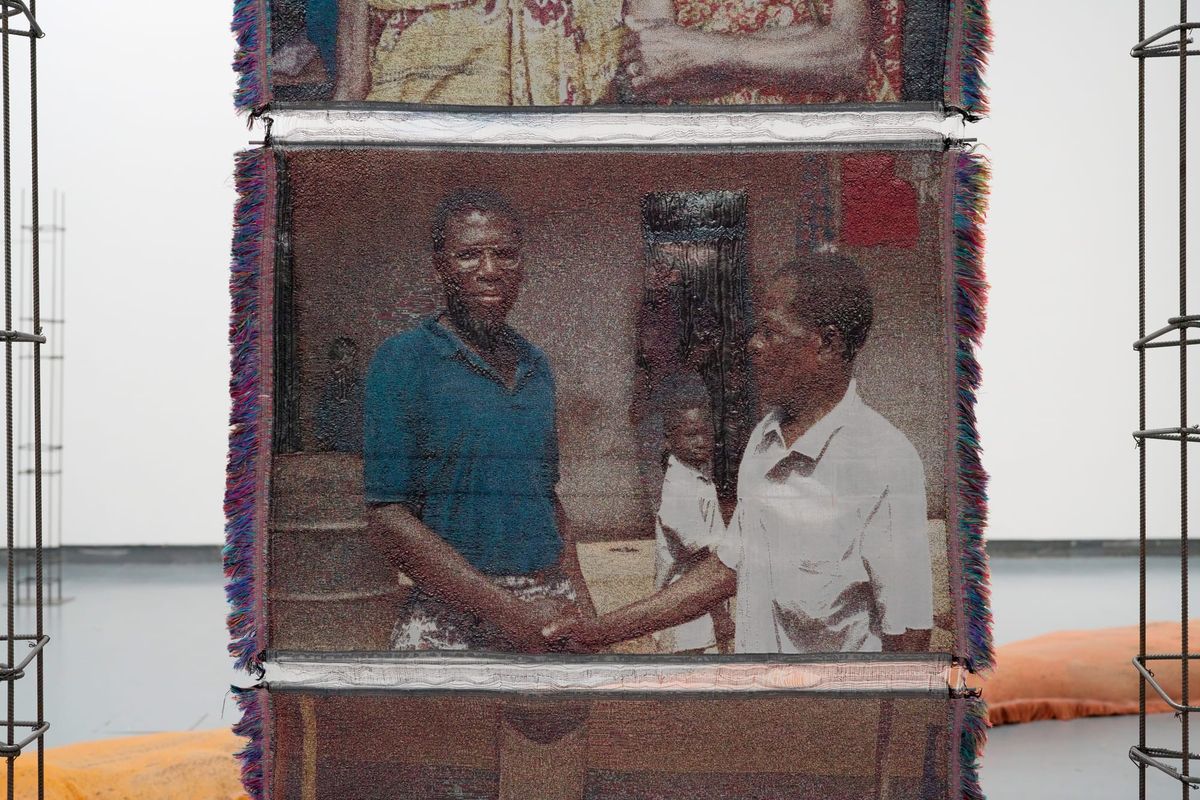
June Drevet: How can we, through photography and film, enter into relation with the world, with history, and with other people? That’s a question that connects the two of us. Since the documentary turn, the documentary has once again (1) been widely criticized, given that pointing a camera at a person or a web of relations always carries something violent: it can objectify or neutralize, tearing people/voices/stories out of their contexts. (2)
The camera has been accused of being a central tool of generalization. To approach this issue, let’s talk about the surface of the image—that is, about questions of rep-
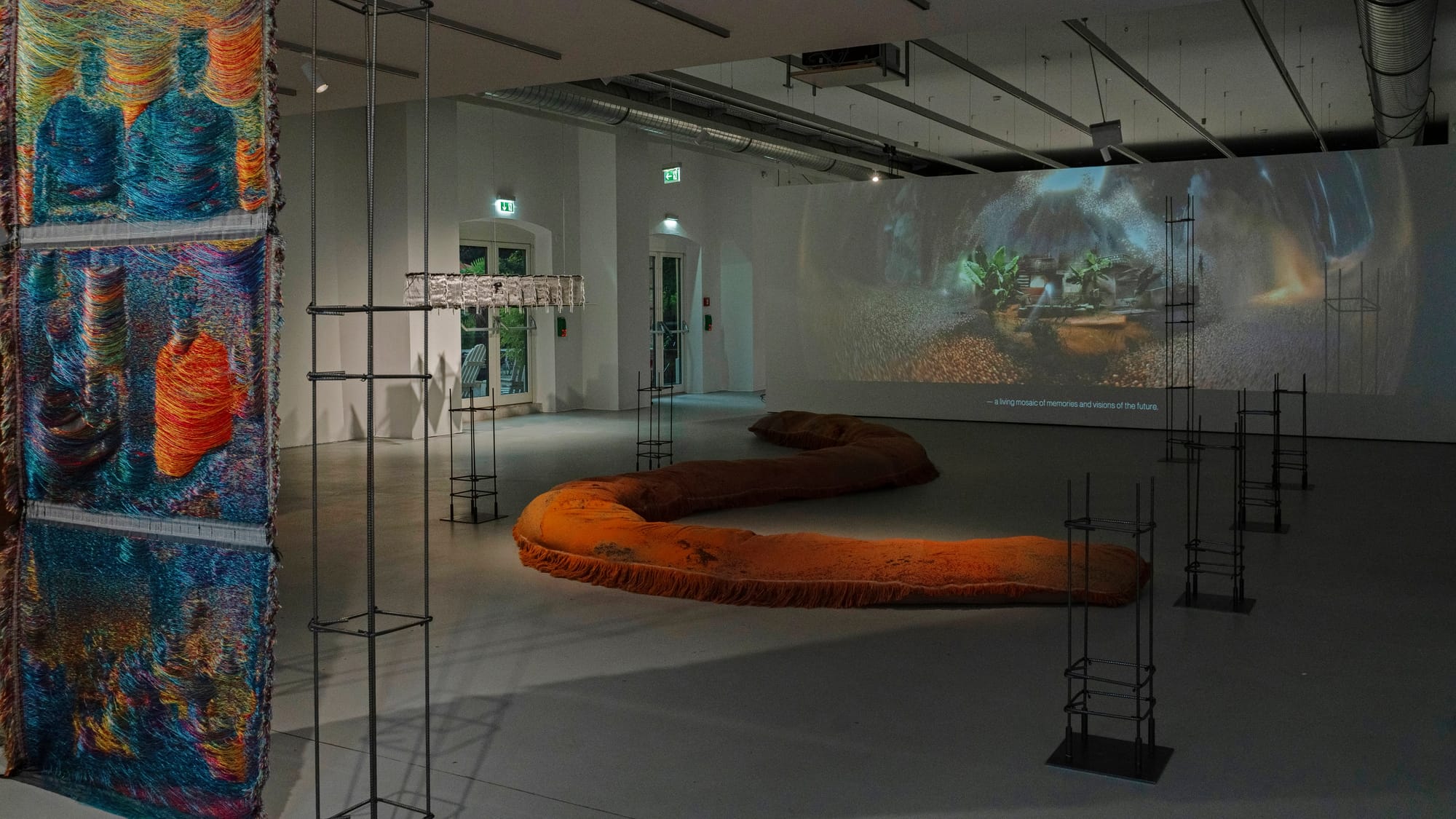
resentation, use, and conditions, as well as about the materiality and technologies involved in observing, recording, and holding on to stories about ourselves and others. What’s so exciting about the two mixed-media installations we’ll be showing in Stuttgart—to which you will also add a third—is that the stories you tell involve your identity and your observation, but they aren’t only yours.
Vanessa Amoah Opoku: As a human, I have to reflect on my own position, the position from which I tell stories about myself and the world. I come from a working-class family. With such a background, your position in society is never self-evident, but it is something you feel early on. Neither going to art school nor not dropping out was self-evident. The first thing that engaging with my own positionality gave me as an aspiring artist was the sense of legitimacy to have a place at all. At first, this legitimation had nothing to do with speaking about myself. What struck me more was that I saw myself represented by people with a similar history, and that was very important to me. The first time that I took my own family history as a starting point was in Bricks and Cement Don’t Make a House. Prior to that, I always resisted telling personal stories. I always had someone else read texts aloud. I never spoke myself because I wanted to maintain a distance and go beyond mere representation. As a marginalized artist, you often show your work in those places where exclusion is happening most directly—where most of the people are not marginalized. That’s an uncomfortable tension: having to negotiate beforehand how much of yourself you show, how vulnerable to make yourself. At the same time, it’s absolutely central to my practice that there is a radical relationality, that I want to touch people on an emotional level, and that requires me to open up and show myself.
Whatever medium I use to tell stories about the world or my environment, I need a medium that makes my presence within the entire construct visible. Positionality doesn’t have to be renegotiated every single time; it’s automatically built into the medium. I learned that from the artist Tina Bara, who was my professor. She frequently uses a series of self-portraits, but sometimes the camera briefly pans to a mirror, allowing us to see both the protagonist and Bara herself. For me, that’s what the LiDAR scan does: how I move has a significant impact on the result, meaning my body is inscribed into the medium.
This early sense of one’s position in society—a sense of class consciousness—is for me the precondition for being able to effectively tell stories with and about others. In my case, this path—from a cacao farm in Ghana, via an education in Hungary, to an artistic practice, teaching, and research in Germany and Switzerland—took two generations.
JD: Absolutely, and at the same time I think that our different ways of working provide different possibilities for deploying class consciousness. In art criticism, the format itself is language, and language is a way of creating discourse. Language allows me to intervene in discourse much more directly: an article can be taken up at the next symposium, developed further at a conference or cited in a lecture. That gives it a different kind of leverage compared to making art, where the work first has to pass through layers of mediation before it becomes discursively effective. And we can deploy, carry out, mark, or inscribe the question of positionality quite differently too.
VAO: How do you deal with that in your writing?
JD: For example, in the beginning I always built in a note on the conditions under which I write or under which a given text came into being. That’s how I learned institutional critique; I noticed that it is necessary to connect content with structure and conditions. But the social misalignments repeat themselves. I can’t point out the same problem every single time. I think this pointing-out has, over time, migrated further and further into the underlying structures, similar to what happens for you. As an editor, I can respond to this concern even more directly. I ask myself each time: How do I invite authors? How do I shape collaboration? Or how do I approach a set of themes? If for nothing else, Camera Austria is a very good place to integrate this engagement into how I handle text production because it’s so open to being shaped by whoever works there. The institution has grown organically with each new editor who’s been part of it. And I think the discourse has, fortunately, become much more complex. I think that every debate— if we see it through to the end together with all the parties involved—gives us something to learn.
VAO: Yes, it only works together. This question of facilitation, by which I mean how we (jointly) make a space possible, is absolutely essential. So how do curators see their role such that it is possible at all to exhibit the work—when it is made accessible to the public—in a space that opens itself up?
JD: Exactly! Mediation is also one of our responsibilities because artists shouldn’t have to explain their work. In particular, they don’t have to respond artistically to every piece of criticism; that’s what institutions are for. Otherwise, individuals would censor themselves. In recent years, artists have become more political; put positively, they’ve allowed themselves to let criticism in. But because of that, they’re also frequently expected to take a position on and speak out about particular things.
VAO: I would still say that’s also a co-creation. It gets interesting once the process and the exchange become part of the work itself. The focus is on relational work: the circumstances under which a work is framed and curated, just as much as in the practice itself. How I work with places and people, and how I make myself visible in doing so. That takes a great deal of time. I need it so that the people I work with have agency over how they're recorded and shown—and so that I can really connect with the places I work, instead of just capturing them quickly.
JD: What I’ve noticed is that your works aren’t there to point out conditions. Quite the reverse: conditions serve as the basis for the works or for the qualities that define the artistic practice itself. Either it’s a collaboration, a long-term project, or it’s working with certain materials and technologies. Can you say, briefly, how do you understand the conditions inherent to the technologies and materials you use, and how do you respond to them? Which conditions feed into your choice of tools and which influence things in terms of image?
VAO: This decision about materials is like a chain reaction. How an image finally comes about has to do with so many loops that are so interlocked with one another that I couldn’t possibly put it all together from the beginning. It’s a process that develops over many iterations. That’s why I work with installation. For me, it’s a way of keeping things mobile so that new combinations can happen.
JD: Yes—with different logics and dynamics pulling in different directions. Some things become visible through the processes that weren’t visible before, and some things are made unreadable in order to produce a different kind of visibility.
VAO: Making infrastructure visible, yes. I have to become conscious of every technology and every material—how it came about, the conditions under which they were produced, their historical significance—so that the decision is made consciously, not out of impulse. On the material level, I often work with different things, but they keep coming back whenever they can fulfill a function. On the technology level, it always comes back to the same tools: field recorder, camera, LiDAR scanner. They’re all sensing technologies that capture some-
thing physically present over time, not through a single, closed-off image.
JD: In previous curatorial projects, I’ve repeatedly engaged with works in which the embodied camera plays a role; a strategy used by feminist filmmakers like Chantal Akerman, Agnès Varda, or Barbara Hammer. The embodied camera is, on the one hand, one that makes the artist’s movement visible but also—you spoke earlier about Tina Bara’s influence—brings you, as the artist, into the image. (3)
Do you also think of the LiDAR scanner and the infrared camera as a kind of embodied camera?
VAO: Yes. I’d say both the camera and the scanner are embodied. The LiDAR scan depends inherently on the movement I make; an image only comes into being through movement. I never use a tripod when I’m filming—it’s always handheld. The image stabilization compensates for the movements I make with my body without it making me or the device invisible. That’s not a contradiction for me but a tension I want: my breath stays visible precisely because the stabilization can never fully smooth it out.
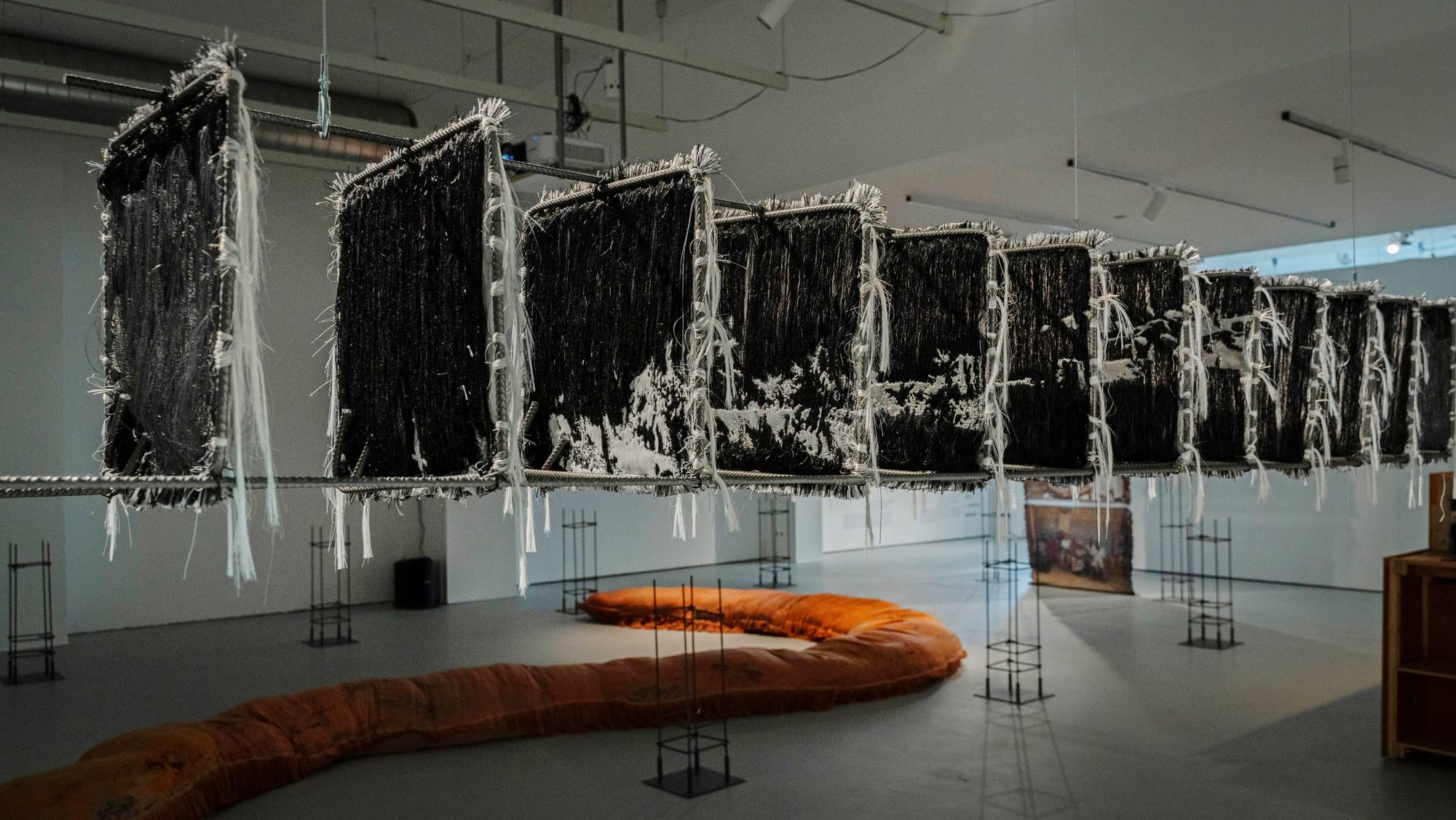
When I tell a story about coloniality, I have to be aware of how weaving has been used in that context, historically and today. When I make a work about bodies, I have to become aware of what wax has meant historically in the process of making death masks while also being aware of the structure of exploitation involved in how humans keep bees for their beeswax. The infrastructure behind it is essential to the logic of the work. Recording is, for me, an active practice: a signal is sent out and reflected. It is just as important to me that reception is active too. Not passive consumption but making one’s own decisions: to step into this space, to open oneself up to the theme or the story, to decide how deep to go, whether to sit down, to pick something up. That is also true for the people I work with and their agency. When I do scans, the person can move and thereby make themselves less visible or more blurred. In both cases, it is less that they are people observing or being observed and more that they are “user-designers.”
JD: That’s interesting because it’s actually not easy to reverse that and become agents again when these technologies are owned by companies. It isn’t possible to use smart technology with an awareness of where and when you leave data traces. When I think of the optimistic texts about the internet in the 1990s, immateriality seemed to represent unseen opportunities. Everyone had the feeling, regardless of their background, that they could see some potential in it for themselves. Today, that’s completely changed. We’re realizing that the possibilities have been capitalized to such an extent that it’s once again a question of rich and poor in terms of who sees opportunities in technology and who doesn’t.
VAO: It’s also the invisibility of technology: this plays with the smooth experience that makes everything disappear into the background so that we never notice how it actually works. That also means we no longer have to develop our own competence. And yet it’s so important that people actively connect with their environment and don’t limit themselves to passively consuming. We have to understand how something is built in order to be able to build it differently or turn it against itself. But that requires competence and awareness—and that, again, is a class question.
JD: Do you know the work of Éric Baudelaire and his exhibition When Night Falls, currently on view at CCA Berlin? For two decades now, he’s been developing new strategies for bringing protagonists who have been invisible, historically or politically, into the image either because they were in hiding, endangered, or have been destroyed; and this isn’t always with people but sometimes with materials, a house, an object. What takes their place instead is often the landscapes, documents, or language surrounding them. One example is What It Is Of (2023/24), for which he built his own device to carry on his great-grandfather’s parapsychological protocols. Called the tychoscope, it is a small, can-shaped drawing robot meant to “bear witness to chance,” which visitors can steer with their thoughts as it puts random patterns on paper. The device is a reenactment of a real telekinetic experiment that Baudelaire himself took part in as a child and then abandoned in 1981. Observation and recording quite literally become the apparatus. I also recently saw Death Passed My Way and Stuck This Flower in My Mouth (2021) in the In Minor Keys exhibition in Venice, curated by Koyo Kouoh. It shows a wholesale market for cut flowers in the Netherlands, where millions of flowers arrive from Africa and South America and are appraised before being sold at auction and then shipped around the world. Baudelaire’s camera roams this vast facility, taking in flowers, the workers, forklifts, and machines. In the five-channel video work Quand le soir tombe (When Night Falls, 2026) at CCA, he shows six locations in France. The footage was shot with a single, largely handheld camera in collaboration with two longtime collaborators.
Unlike the tychoscope, which addresses a personal story, Baudelaire montages societal systems of order (industry, norm, security) against one another in Death Passed My Way. The most striking works at CCA are twelve touchable cherrywood sculptures developed together with blind students from the Institut National des Jeunes Aveugles in Paris. These cherrywood sculptures exist because touch offers a tactile point of access to the work. The way he works with looking versus touching resonated with me, and it made me think about whether a related gesture inhabits your scans and your wax coatings. With the wax, is it more that an image exists first and then becomes illegible or is translated into another sense despite begin-
ning as visual? In relation to this sculpture in particular, is your work primarily visual and then translated—or is it the other way around, going through touch first?
VAO: Yes, I’d say that because this process matters so much to me, the visual arises out of touch. My scans record a touch made with light. That’s why it’s also logical for me to lead everything back into something that can be touched. The visual level remains just as important; it’s just not always the first thing that comes into being. What matters to me personally is the transmedial practice. In the strict sense, it is not about repeating the same story across different channels but about each medium contributing an independent, irreplaceable part. The LiDAR scan can do something the camera can’t, and the wax something the image can’t. That also makes it accessible on multiple levels, for me and for the person I’m with, and there’s an openness to be able to respond to what’s actually there. With the LiDAR scanner, for example, I can only respond to something that’s physically present, and once it’s no longer physically present, I have to respond differently. The visual
level doesn’t have to carry everything; the auditory level doesn’t have to carry everything. In Breathing Room, the visual level also gains a material, sculptural dimension through the beeswax—one whose task isn’t to conceal or to reveal something but to give back a form of corporeality to the voices present in the room.
JD: We’ve talked so far about producing ruptures, tearing open and doing away with things in order to be able to reassemble fragments differently and create something new. An example of this for you could be the house or your parents’ arrival at their own home. In a footnote, Erika Balsom explicitly points to Eve Kosofsky Sedgwick’s concept of reparative reading. In it, Sedgwick describes the reparative stance as a practice of assembling rather than dismantling, of strengthening trust rather than exposing false consciousness, of love rather than suspicion. Sedgwick describes the reparative position not as the restoration of an original whole but as an assembling of fragments into something that resembles a whole—one that isn’t necessarily coherent, that isn’t asserted but where the approach itself remains visible. And that matches what I’m after in writing: for instance, pointing to the structures underlying a work. Or allowing and sharing observations that arise beyond what the artist intended.
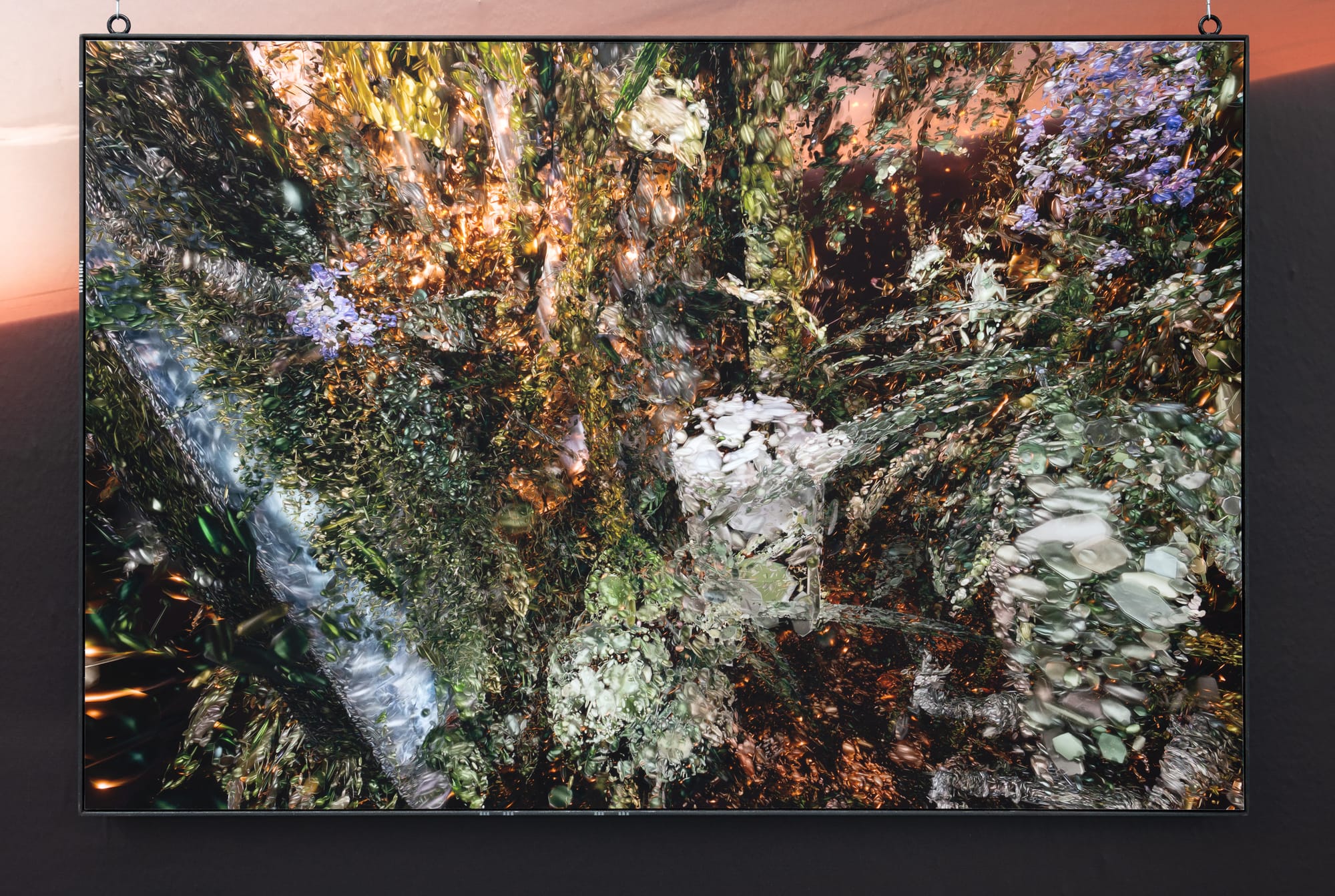
And it’s actually what you once said about point clouds that aren’t just strung together: “...though not necessarily like any preexisting whole.”(4) That maps exactly onto what you once said about your algorithm, which deliberately doesn’t compute a mesh. Or the rules you set up within your work to never develop
a closed form while still having stability at the same time so that it can stay loose. Or when you bring the cacao trees from Ghana, Brazil, and a European garden together into a new digital space. There is also a second point I think is important where Sedgwick describes hope (“often fracturing, even a traumatic thing to experience”) as one of the energies with which the person doing the reparative reading tries to organize “the fragments and part-objects she encounters or creates.”
VAO: Yes, absolutely. Thank you for laying that out. On the one hand, my practice is something like justice-driven: I feel a responsibility to fight for justice. But assembling is also just as central for me. And when Sedgwick speaks of the fragments a person “encounters or creates,” it captures exactly what I mean by encountering: I don’t just create the fragments; I encounter them.
JD: In our first conversation, we talked about building (and, in the best case, also transforming) instead of consuming. How do you situate Breathing Room within your work so far, and what’s still to come?
VAO: Breathing Room, together with Bricks and Cement Don’t Make a House, is part of a triptych. I say triptych because, for me, that’s a spatial term: the works don’t follow one another sequentially but exist simultaneously. Breathing Room is the second work in which I speak with people from the second generation of the diaspora. The next work would need to be conversations with people from my parents’ generation. Bricks and Cement Don't Make a House was the first, looking into the past and, at the same time, into the future, asking what fragments there are that can be temporarily assembled so that we can build a foundation just stable enough to reconnect on. A very emotional, very exhausting but also a very beautiful work because it took place across different continents, across different periods of time, with people I can no longer ask. One central circumstance was that people hadn’t spoken to each other, hadn’t stayed connected, and I had to try to bring this connection back after the fact while wanting to keep the gaps visible.
JD: In a way, breath could also be an image strategy of touching, or a method that is physical. What do you think?
VAO: Breathing Room came very clearly out of an impulse to take up space, to breathe. In the beginning, I still thought this could be a pause or a temporary place where we could let go for a while. But over the course of the process, it turned out to be much more about voice because breathing is also bound up with voice: if I have no breath, if the air leaves me, I also can’t speak. That happens through migration, through war. It’s a trauma response, not being able to talk about something, and it’s something I kept encountering in the conversations I’ve had. Really, it’s much more about voice here and about sharing one’s own story. Breathing Room, through sharing, creates space to breathe, to face one’s own story despite a lack of breath, and to share it with others; that’s also what breath stands for.
JD: Like a place of restoration, but not as a retreat or pause, rather through listening to others and becoming a witness to their story.
VAO: Exactly. But only as long as we dare to stay open while we do it.
//
This conversation was originally published in "Synthesizing Realities", a book that accompanies the eponymous exhibition at ifa-Galerie Stuttgart, Germany, curated by Vanessa Amoah Opoku in collaboration with June Drevet.
Footnotes
(1) For a good overview of the term and the discourse, see the three editions of the Berlin Documentary Forum (2010–14), curated by Hila Peleg at Haus der Kulturen der Welt, Berlin, out of which came the book Documentary Across Disciplines, eds. Erika Balsom and Hila Peleg (Berlin: Haus der Kulturen der Welt; Cambridge, MA: MIT Press, 2016).
(2) See Susan Sontag, Regarding the Pain of Others (New York: Farrar, Straus and Giroux, 2003); Hito Steyerl, Die Farbe der Wahrheit [The Color of Truth] (Vienna, 2008); Hito Steyerl, "Documentary Uncertainty," in Re-visiones, no. 1 (2001), http://re-visiones.net/spip.php?article37; Ariella Azoulay, "'The Family of Man': A Visual Universal Declaration of Human Rights," in The Human Snapshot, ed. Thomas Keenan and Tirdad Zolghadr (Berlin: Sternberg Press, 2013), 19–48; Saidiya Hartman, Wayward Lives, Beautiful Experiments (New York: W. W. Norton, 2019).
(3) Cybelle H. McFadden, Gendered Frames, Embodied Cameras: Varda, Akerman, Cabrera, Calle, and Maïwenn (Vancouver: Bloomsbury Publishing, 2014).
(4) Eve Kosofsky Sedgwick, Touching Feeling: Affect, Pedagogy, Performativity (Durham: Duke University Press, 2003), 123–51, here 128.