
Rib is housed in Oud-Charlois, Rotterdam South, in a space that was once a perfume shop, then a Dutch butcher’s, and most recently a Moroccan butcher’s that went bankrupt.
Founded in 2015, the art space extends beyond its exhibition room into a temporary recording studio, an experimental garden that was once a vacant lot, and relationships across the neighborhood. Charlois itself was once an independent agricultural municipality until Rotterdam annexed it in 1895. That history matters to the geography of this conversation: the neighborhood is a place with its own institutions, memories and everyday encounters, not simply a location awaiting cultural activation. [1–2]
The garden makes that outward movement tangible, whilst this conversation begins outside of the Van Abbemuseum in Eindhoven, where Maziar Afrassiabi, Senior Curator in addition to being the founder over in Charlois. We meandered around the idea of how a curator who describes himself first as a “neighbor” navigated within an established institution. We chatted over freedom through improvisation, decision-making processes—easy and tough ones—and at institutional transformation without making false promises.
María Inés Plaza Lazo: You didn’t simply find a job in Rotterdam—you created one. Before we enter the museum, tell me how that happened.
Maziar Afrassiabi: Not in a straight line. I graduated as an artist in Utrecht in 1997, had some exhibitions and then formed a collective there. There were seven of us. At some point, three of us left and formed a band, Applegarden.
MIPL: What kind of band?
MA: It was a mixture of very different styles. We were all pre-teens in the ’80s. At eleven, my biggest influences were Michael Jackson’s Thriller, which I listened to on a cassette player in Iran until the tape wore out (I can still smell it), and Rufus and Chaka Khan’s “Ain’t Nobody”, which I heard on a VHS tape of the film Breakin’. The tapes were smuggled in with their plastic cases removed, carried in someone’s pocket from the US, then duplicated and put into new cases, all before the film had even arrived in Europe, or so I was told.
In the band, we had organs, samplers, percussion, bass, guitar, and falsetto vocals, and the three of us took on different personas and temperaments. There is a video of a song called “Armageddon” from a local television appearance on the Euromast. We began in 2002 with an eclectic, almost Vaudeville-like album, recorded in a friend’s studio without ever playing it live. Over time we moved toward the dancefloor, with energetic live shows mixing electro, disco, and synthpop, including a memorable concert at the Effenaar in Eindhoven.
What I loved in the rehearsal room was experiencing how songs emerged over time: from stuttering conversations and half-baked phrases repeated over and over, until something matured, with lunches and conversations over coffee and tea in the garden in between. We would just start, and slowly the energy and mood of the day would be translated into a song. It was magical and addictive. Playing for an audience made me realize that every live performance is an event. A song isn’t simply reproduced; each time it’s an attempt to tune it, live, to the energy of that particular crowd.
In 2006 we released a 12" on Clone Records. In 2007 we toured Moscow and St. Petersburg, where, surprisingly, and unlike in Rotterdam, the crowds knew the lyrics by heart. We left our organs there; they were too heavy, and then we stopped.
MIPL: Which organs?
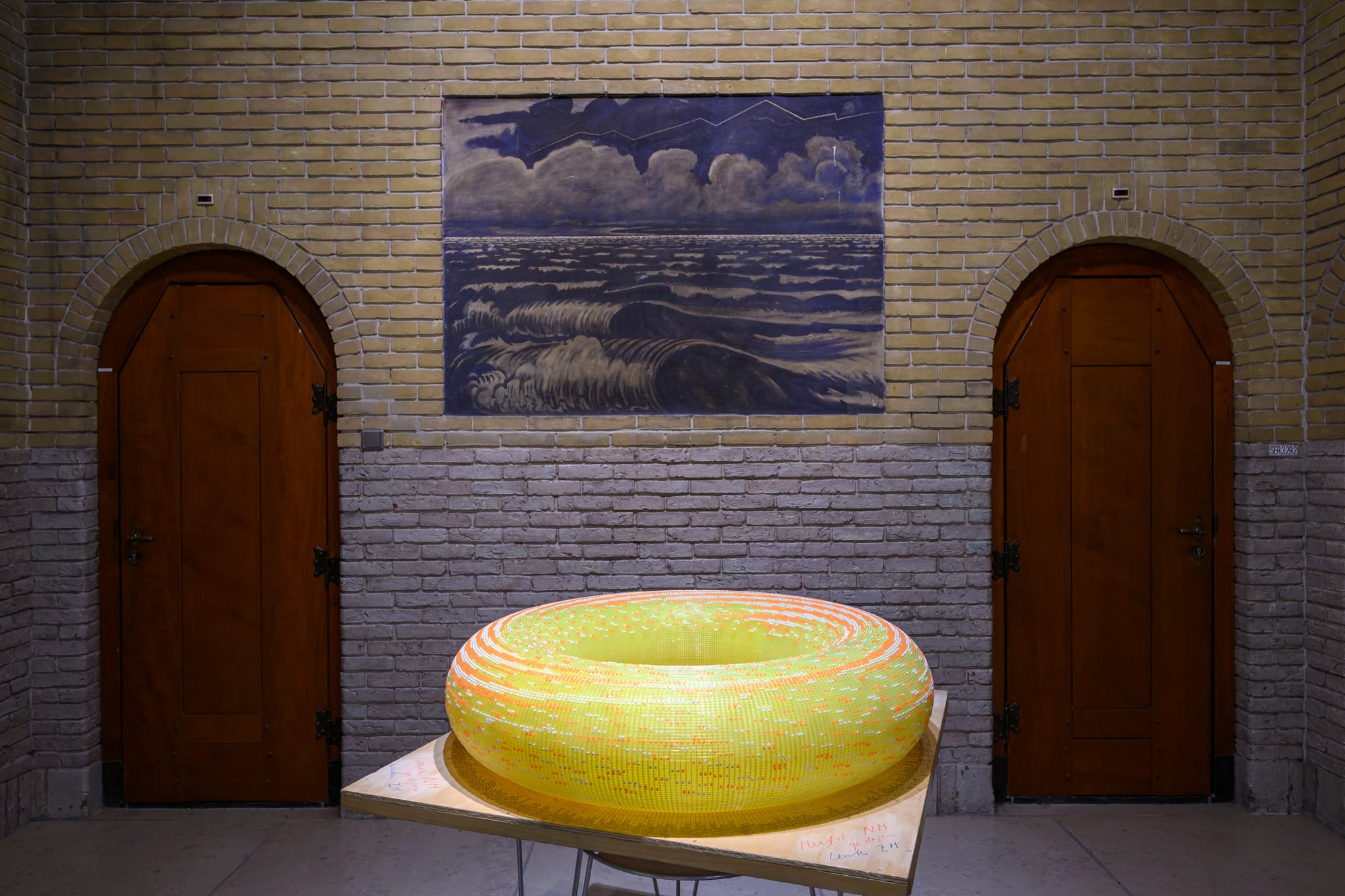
MA: A Philicorda—an amazing transistor organ made by Philips. I bought another because I’m so attached to it. And a Davolisint, really more a monophonic organ than a synthesizer, the first Italian synth. We found it in the rubbish one day.
MIPL: So collaboration came before curating: first a collective, then a band, and then?
MA: After the band broke up in 2007, my way back into art was through Treignac Projet, an artist-run space run by Sam Basu and Liz Murray in a remote village in France, in what had once been a hospice and later a yarn factory. I went there a few summers, where young artists from different cities in Europe and beyond gathered for a few weeks. For me, it was a retreat, a place to rediscover my initial excitement about art. From early morning until dinner, everyone presented their work, or whatever they were busy with at that moment, followed by intensive discussions and critiques. At night we partied. Those conversations were important to me: after leaving art for music, they let me return to it devoid of its politics, at least temporarily. In those years I was simply looking around while working side jobs. I started a master’s in social sciences but didn’t finish it, realizing that academia was neither my language nor my method. Meanwhile, art itself was moving into the university: artistic doctorates were spreading, and making art was increasingly becoming formulaic, a matter of research proposals and project management, jumping from one project to the next, rather than a process of discovery and evolution over time.
MIPL: How did that lead to running a space of your own?
MA: In 2013 I started working at Objectif Exhibitions in Antwerp as a coordinator and producer. Then came a new funding round, and, with it, discussions about merging Objectif with Extra City and sharing the funds. In the end Extra City continued and Objectif closed in 2015. Antony Hudek, Objectif’s last director, now leads Extra City.
I think experiencing an institution coming to an end after fifteen years—and the questions it raised about to what ends and by which means—somehow informed Rib’s program. It became explicit in our program “The Last Terminal: Reflections on the Coming Apocalypse”, which started from the premise that continuity is perhaps more bearable if you embrace your own demise from the outset. That idea came from the death of Albert Lamorisse, the director of The Red Balloon. In 1970, he was making The Lovers’ Wind, a poetic film about Iran commissioned by the Shah’s Ministry of Culture. He had worked on the assumption of creative freedom and had already finished the film he envisioned, but the Shah was dismayed: it showed a pastoral, ancient Iran, not the modernizing country he wanted to promote. Lamorisse was called back to film industry, a nuclear reactor, and dams. He voiced concerns about the power lines around the Karaj Dam, but finally gave in and flew with the Shah’s pilot. The helicopter caught in the wires and crashed, killing him and the pilot. His camera was recovered from the bottom of the reservoir. His widow, Claude Lamorisse, and their son Pascal, together with editor Denise de Casabianca, completed the film from his notes, and the recovered footage became a short postscript, released in 1978, just months before the revolution. It ends over the dam, and the abrupt cut where the recording stops expresses a full merging of his death and a film cut short more vividly than anything else could. This story and the films became a generative principle for the program that followed, which, to be honest, I’m still not sure has ended.
Seeing the inner workings of Objectif up close, without curatorial responsibility, I realized that an art space could be the right structure for me: a rich, layered format and infrastructure to work with and orchestrate, where making exhibitions becomes a form of time-based engineering. There were many empty shops in my neighborhood, and one day a housing corporation showed me what was available in Charlois, adding that within four years the neighborhood would be fully gentrified and they could ask the full rent. I chose the former butcher’s shop Chaattouff, where I used to buy my meat, and called the space Rib, to at least minimally honor the fact that its tragic demise made our emergence possible.
The first exhibition was deliberately unspectacular: a well-lit, almost empty white cube titled “4 works, 3 artists, one projection”, with Steve Van den Bosch, Christoph Meier, and Axel Stockburger. Its starting point was the question of launching a new art space itself. Meier and Stockburger showed Il Grande Silenzio, a film for which they turned an art space in Vienna into a film set and staged an exhibition opening, with fellow artists acting as guests and contributing fake artworks as props: black humor, punk attitude, and plenty of fake blood. That is where Rib began. My professional practice, as it is now, only really started and consolidated once I had landed in the space, inhabited it, and become its caretaker and interior designer. It all made sense, also because my son had been born the year before.
MIPL: How do you understand your relationship to Charlois?
MA: I have lived in Charlois since 2001; at some point we also rehearsed there with the band. So I didn’t arrive to work on “the neighborhood”. Rib grew quite quickly in terms of funding, but I soon became aware of the transactional nature of survival, and I had to find ways to negotiate the expectations that come in exchange for money. Accepting that reality and formulating a response in artistic terms partly shaped the program and Rib’s relationship to Charlois.
An undercurrent in my work was to show that public outreach or serving target groups is not what makes you a genuine neighbor, because neighborliness is a non-intentional social form. Learning from Lamorisse’s story, I wanted to relate to external expectations and dependencies differently: as something consistent with my artistic vision, not as mandatory, supplementary window dressing. But also without being privately antagonized by them while keeping up appearances on the outside. I take neighborliness as a basic social mechanism for living with the reality of co-existence in this world: a way of being true to others through being true to oneself, as opposed to a tasteless, or taste-free, extraction in which one subjectivity projects itself onto another.
That is the subtext of the festival Het Zuid Manifest, “I Love Carlos”, and its second edition, “Carola Loves Carlos”: imagining Rib extending into the public realm as an exhibition space.
In fact, what art you show in, say, a barbershop run by a Turkish immigrant who is also a friend is only relevant insofar as you really love the work and not because it was chosen for a representational agenda.
MIPL: Or in a mosque.
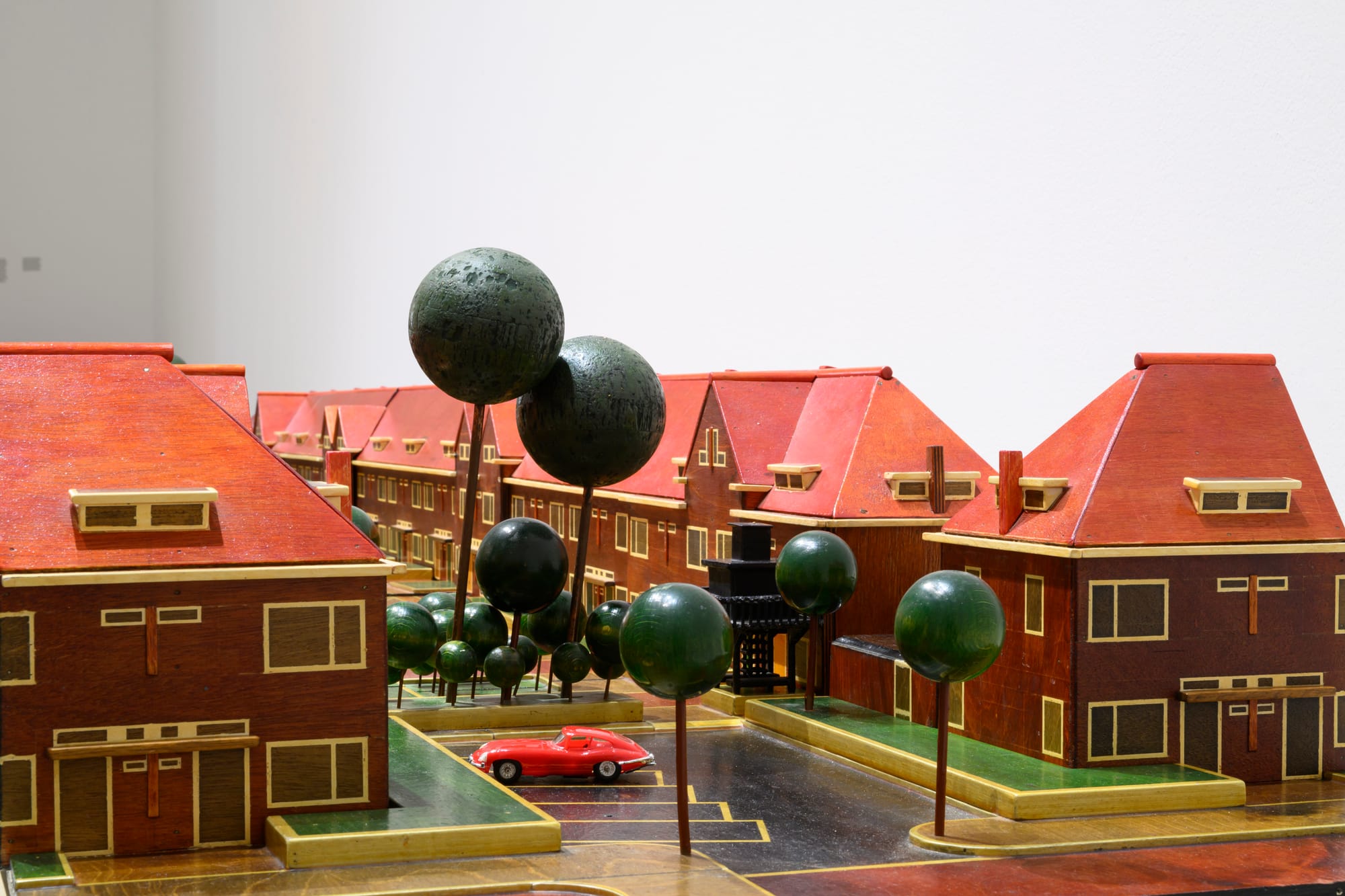
MA: Or a publicly, architecturally or legally suspended theme park. For me, the proximity of the world is contingent on how one navigates these so-called “worlds” without a destination in mind. Perhaps it helps that my journey hasn’t been linear or that I was educated as a curator. These aren’t separate worlds that I first had to learn to connect.
Rib’s neighborhood festival is Het Zuid Manifest. The documented 2026 edition, “Carola Loves Carlos”, spread across seventeen locations in Charlois, including a barbershop, a kebab shop, a florist, a church, a historical association, and a café. Visitors could choose their own route. The distributed format gives a concrete setting to the conversation about encounters beyond the exhibition room. [3]
MIPL: I came across the phrase “post-institutional curating” in relation to your work. If artistic production can operate beyond conventional hierarchies, what does “beyond” actually mean?
MA: It doesn’t mean hierarchies don’t exist. It means you can navigate them all. Being in one position doesn’t stop you from occupying another. You can move between them and mix them up. It is about having a broader habitus.
Often the available roles seem to be either a social worker in a neighborhood or a high-profile curator working only in museums and biennials. Neither division makes much sense to me.
MIPL: You grew up in Isfahan and came here at thirteen, during the Iran-Iraq War. Now you are looking back on that experience as an artist, a curator, and a parent. You don’t only share struggle but also the joy of diasporic being. What does an independent art space know about having fun that a museum might have forgotten?
MA: What interests me is the movement between the artist-run space and the museum. In a way it’s a double existence, much like diasporic life: you live contrapuntally, as Edward Said put it, with two melodies playing at once. It isn’t exactly harmony. From a single perspective, things are easily romanticized or reduced: the artist-run space as pure freedom, the museum as pure bureaucracy, the homeland as paradise lost, the new country as salvation or exile. There is pain and joy at once in never arriving, but I’ve come to think that is the whole point.
An artist-run space and a museum are both machines, just at different scales. A museum has the means to make extraordinary things possible; an artist-run space has the lightness to try things before they make sense. But both are possible at either scale. Ivan Illich wrote that every institution enhances our abilities up to a certain threshold, and beyond that point it begins to disable the very people it was meant to serve. That threshold exists for both. So the question isn’t which one knows how to have fun, but how to have fun anyway.
For Robert Filliou, art is what makes life more interesting than art. That’s what I’d like to keep alive, at Rib and at the Van Abbemuseum
MIPL: The tension between artistic freedom and institutional responsibility is familiar. Your situation makes it unusually concrete: you continue Rib while working as Senior Curator at the Van Abbemuseum. Many institutions would not allow that; they’d rather swallow you than let you be.
MA: To give an example of how different that responsibility can be from what I was used to at Rib: during “The Last Terminal”, we let an artwork switch off the entire space, including the exhibition itself. Mathew Kneebone’s Power Relations linked Rib’s electricity, in real time, to power outages in California. Whenever California blacked out, so did Rib, including the works of the other artists in the exhibition, and no one knew when the power would come back. We would handwrite notes on the door copied from shop windows there, like “Power out / Cash only.” In a way, the moment the power went off was when the exhibition was switched on and revealed itself: in the darkness, and the particular quiet we know from outages, one could almost physically feel a presence. I can imagine that in a museum, that kind of gesture is far more complicated.
Similarly, we recently discussed a deteriorating Joseph Beuys piece in the collection. The question was whether the museum should conserve it or let it follow its natural process of decay. Beuys was known to be ambivalent about the preservation of his work, unlike, for example, Dieter Roth, who made it clear that his works could simply be left to rot. My first instinct was to ask whether we could find a way of keeping the decision open, so as to preserve the ambivalence of Beuys’s own position. Just to say that whatever the final decision, the possibility to have a conversation with colleagues (who know the collection far better than I do) excites me.
MIPL: Perhaps it is not that the museum cannot accommodate that uncertainty, but that it cannot bear it.
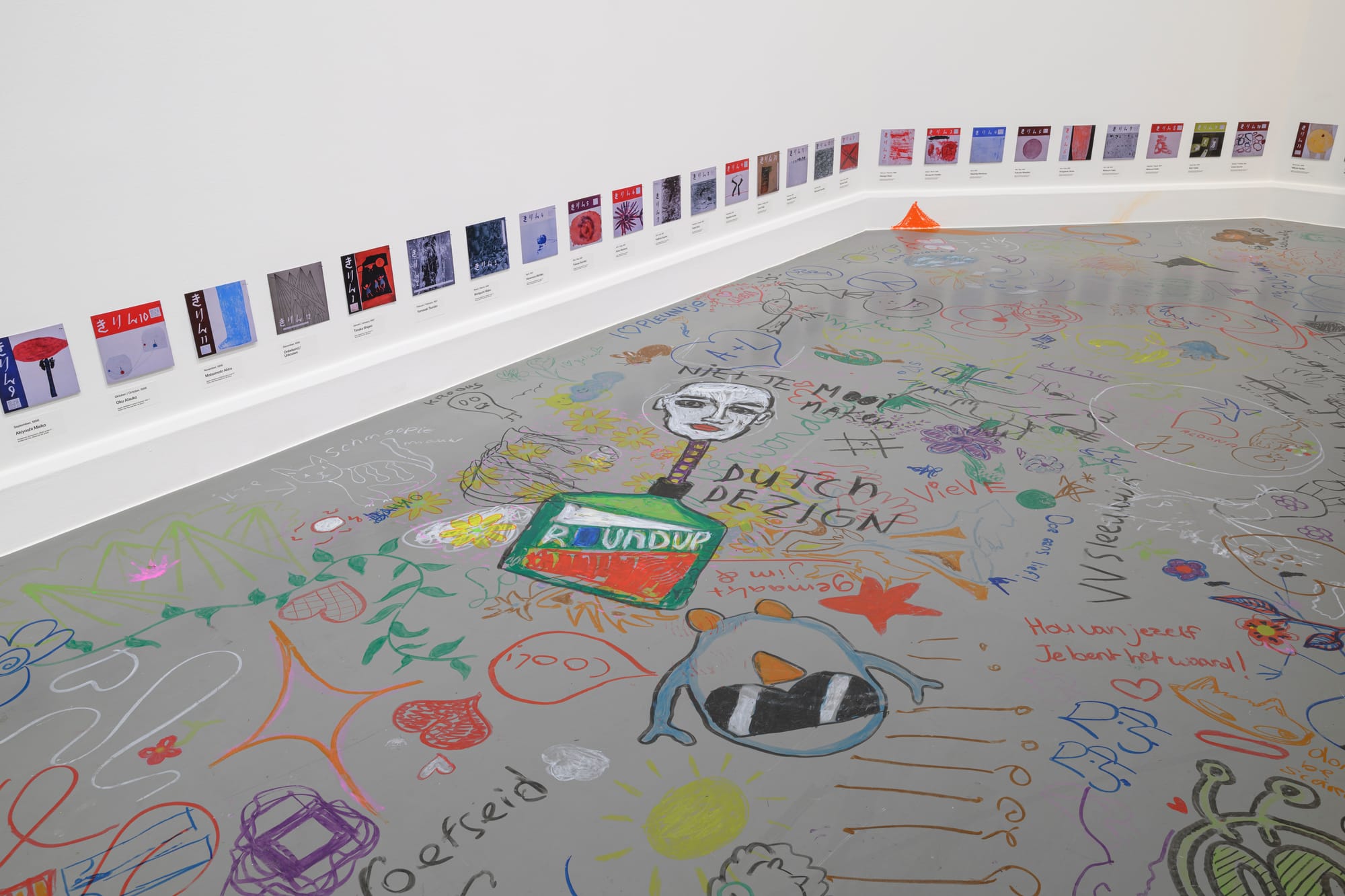
MA: Of course this is just an example, perhaps even a metaphor, for how a change of perspective that, at first, might seem to contradict the museum’s mission can open up new possibilities for structurally reimagining what a museum can be. You’re right that it’s a question of bearing rather than accommodating. Institutions are built to decide: to classify, to conserve, to be accountable. Irresolution can feel like a failure of responsibility. But what if it were taken seriously as a working principle? How might one organize around that? The position could be to keep the collection, and ourselves, in motion: to treat means not as steps towards an end, but as something with its own value, what Giorgio Agamben calls “means without end”. In that sense, bearing irresolution may be one of the most generous things a museum can offer, both to artists and to its public.
MIPL: You also mentioned artist Michael Portnoy. Did a different possibility open up in that collaboration?
MA: In The Fifth Place, part of “Museum as Sundial”, we managed to realize what Michael had in mind by turning to discarded materials from past exhibitions in the museum’s storage. Michael’s openness and Christian Wassmann’s remarkable spatial insight allowed us to work with what was already there. A related question that has long interested me is: where does an exhibition actually take place?
MIPL: When does it happen?
MA: When something unexpected emerges. That’s why, with the festival, I don’t start from a theme. Themes usually rest on a consensus about what is considered relevant, on commonly held beliefs rather than on difference—even when they are marketed as daring or new. Those beliefs are often borrowed from academic or social-scientific discourse, which has its own value, but in an exhibition the works then risk being asked merely to confirm them. Jacques Rancière would call that the logic of consensus, as opposed to dissensus, where something appears that doesn’t fit the existing distribution of what can be seen and said. For me, art and exhibition-making are about discovery, about making a difference. Not in the modernist sense of novelty, the new for its own sake, but in the sense of an event, as Alain Badiou understands it: something that emerges from a specific situation, yet can’t be deduced from what is already known, and that can only be prepared for and then responded to faithfully.
So I try to engineer the conditions for encounters, always in response to what is already there: the place, the people, the works. Of course I bring my own understanding and my affinity with certain practices; that doesn’t disappear. But I don’t choose artists because they fit a theme. I think that can be a trap. The philosopher Tristan Garcia, who worked with Badiou, describes an exhibition as neither a gesture nor a representation. When a theme comes first, the exhibition easily becomes both: the curator’s gesture, with the works reduced to illustrations of a statement. For Garcia, the one who arranges an exhibition should be ready to withdraw, so that things can appear on their own terms.
MIPL: What does that trap look like from the outside?
MA: Imagine scanning exhibitions around the world from the past three years. There is something indistinguishable about so many of them: the scenography and the way people carry themselves in it, the atmosphere, the themes, the language of the press releases. They keep replicating one another. Seen in isolation, each exhibition is a gesture of distinction, a bid to be noticed and recognized. Taken together, they turn into a kind of mutual recognition society: each validates the others by simulating them. Theodor Adorno and Max Horkheimer already noticed in the 1940s how the culture industry stamps everything with sameness, even as it promises variety. In 2012 Alix Rule and David Levine analyzed thousands of e-flux announcements and identified what they called “International Art English”, a shared, almost interchangeable dialect in which exhibitions describe themselves. I don’t exclude myself or the institutions I work with from this; it’s a condition we’re all part of. But that’s precisely why it matters to notice it, so as not to be reduced to an automaton on an assembly line, and to try to preserve the specificity of each encounter between a site, the artworks and their publics.
MIPL: On my way to Eindhoven, I was thinking about the art world as an ecology. Some artworks and spaces are cultivated like beautiful plants; others seem parasitic, or behave like the insects we are tempted to remove. The fact that something doesn’t fit our plan may be precisely why we shouldn’t eliminate it.
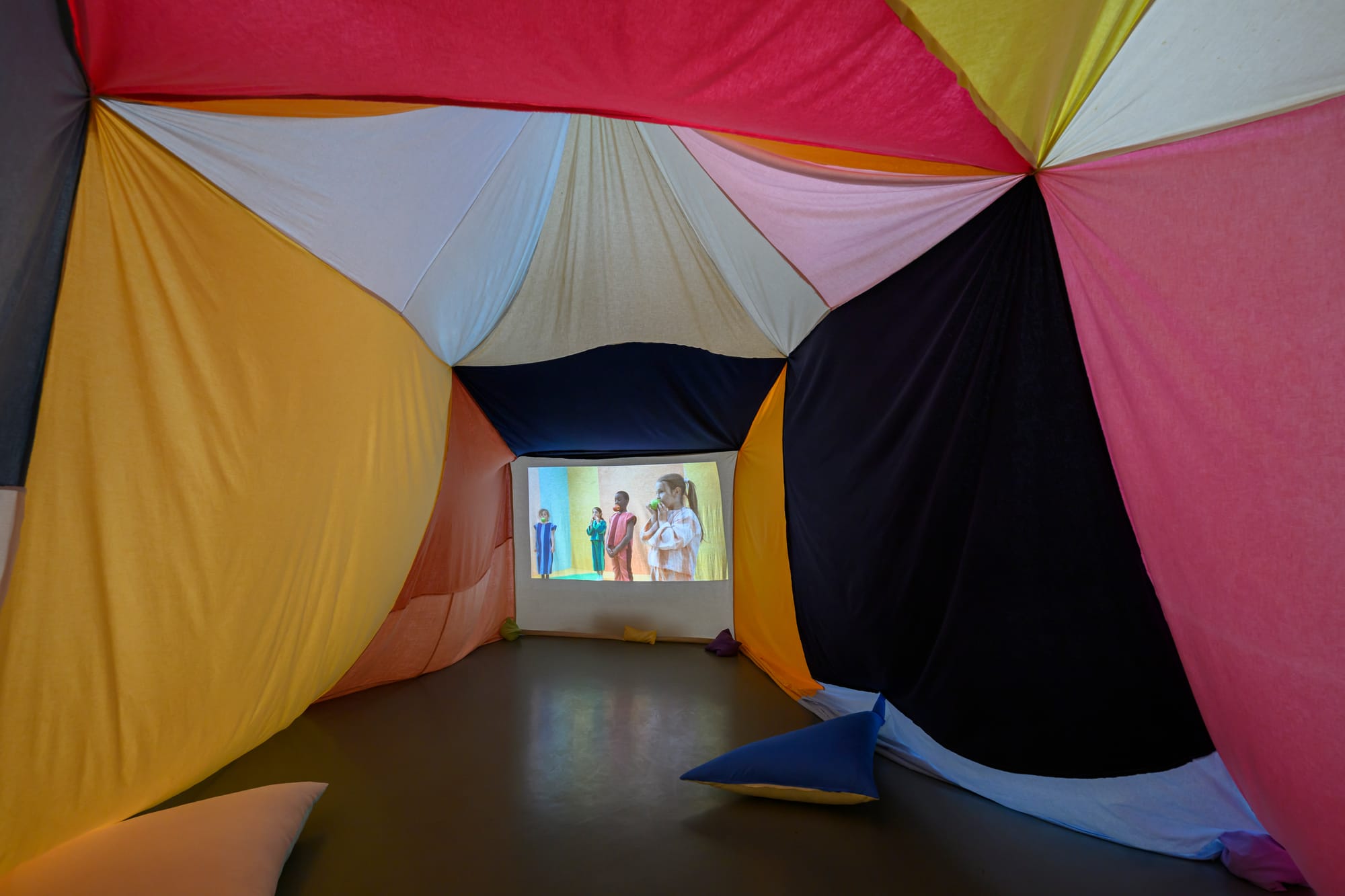
MA: Exactly. And you can kill something even with a gesture intended to be subversive. Once you label something subversive, it doesn’t necessarily stay what it was. The Situationists had a word for this, récupération: the way a system absorbs what resists it, often simply by naming it, framing it, giving it a place. The insect becomes a specimen. I like your ecological image, because it shifts the question from what deserves to be cultivated to what we tolerate not understanding.
The philosopher Yuk Hui describes how today’s technical systems are recursive: they absorb contingency, turning the unexpected into feedback that only makes the system stronger. Institutions, including art institutions, can work the same way. The question for me is whether we can still make room for what can’t be absorbed.
MIPL: So how do you bring those less predictable realities into a museum—the city, politics, or the things the exhibition format cannot anticipate?
MA: Honestly, I don’t have a formula. I’d rather work with small gestures over time, working with or re-engineering the existing conditions of im/possibility, which reveal themselves once you’re willing to notice what usually goes overlooked. Take a simple idea as an example: if we accept that an artwork’s presence doesn’t depend on size, production complexity, or budget, what would the consequences be, both for the museum and for the public?
MIPL: You have an ambition, but you are not promising its fulfilment.
MA: Right. Another trap would be to arrive saying: I want to do this. I will do that. This is what will happen. I don’t know that yet. There’s no shortage of ideas, but time and timing are essential. You have to be ready for when the circumstances present themselves.
MIPL: What interests you in inviting artists as System Thinkers rather than only asking them to make an exhibition?
MA: System Thinkers is a long-term initiative Defne Ayas introduced: rather than only making an exhibition, artists are embedded in the museum’s thinking and operations for two years, as co-authors of how it works, from education and mediation to its civic role. It resonates with my own long-term collaborations with artists, where time and care are taken to cultivate relations, forms of thought, and infrastructures, and to let them emerge and evolve into something transformative. In both cases, artistic thinking is at the center of thinking about systems, not added afterwards as illustration.
For example, on 13 November we’re launching “Design Collapse”, a series of Exchange Tables initiated by john gerrard, which I’ve been shaping with john. It starts from the relationship between design and today’s polycrisis. Ecological, technological, and social systems are under such pressure that collapse is no longer a futuristic image, nor something happening elsewhere; it is everywhere and systemic. Since so many of our systems are designed, this is arguably also a crisis of design, a design collapse. The series turns that around and asks whether collapse itself could become a design method. Around a table at the Freedom Theatre in Sectie-C, here in Eindhoven, we bring together people whose practices may be incompatible or complementary—people who wouldn’t naturally meet within the same university system—with an invited audience made up mostly of students from different academies and universities. In effect, 13 November is a foundational session for john’s long-term engagement with the museum.[4]
MIPL: Even if the positions cannot be reconciled?
MA Yes, even then. Reconciling positions isn’t the goal; having a real conversation is. There’s a dinner, a hospitable setting in which to meet, and it’s also about reaching the underlying, less conscious levels, not only exchanging positions that everyone has already formulated.
MIPL: Where does refusal sit in that structure? Refusing to participate in institutional transformation might itself be a valuable form of systems thinking. Someone might decide that entering the system is precisely what they don’t want to do.
MA: You mean that the moment you enter a system, you risk being depoliticized or neutralized?
MIPL: I think that risk is high.
MA: You’re putting me on the spot. It would be too easy to say that admitting our failures or being transparent about them is the answer. I don’t think simply saying that resolves the problem.
MIPL: "System Thinkers" could be read as a continuation of institutional critique. But “system” is a slippery word. What changes when you make that framework?
MA: What I can imagine it enabling is a different understanding of how entities and forces are entangled. If you approach an institution through a specifically decolonial framework, for example, certain relationships become visible. Looking through systems thinking may reveal a different layer. The first step is to bring these into view. “Design Collapse” is exactly about asking that question.
MIPL: Let’s return to where we started. At Rib, you have been constructing an alternative institutional ecology. At the Van Abbemuseum, you are working within an established one. Do the "System Thinkers" let you bring an instituting logic into the museum—or reveal the limits of trying to transform it from within?
MA: I hope the latter, which I think is a crucial step. After that, we will see who or what has been transformed or recuperated. It is something we want to find out. I see System Thinkers as a diagnostic tool, both the tool itself and the context in which it is going to operate.
//
References
[1] Rib, About. Headquarters in a former butcher’s shop, recording studio and garden: https://www.ribrib.nl/about
[2] Stadsarchief Rotterdam, Charlois. Independent agricultural municipality and annexation in 1895: https://stadsarchief.rotterdam.nl/charlois
[3] Rib, Het Zuid Manifest: “Carola Loves Carlos”, March 26–29, 2026. Full seventeen-location program: https://www.ribrib.nl/het-zuid-manifest-carola-loves-carlos
[4] Van Abbemuseum, The Van Abbemuseum launches System Thinkers. Inaugural cohort and program: https://vanabbemuseum.nl/en/see-and-do/online/the-van-abbemuseum-launches-system-thinkers