
María Inés Plaza Lazo: By way of a prologue, I’ll note what you mentioned to me earlier: the sundial as a technological construction that makes light and shadow move according to the geographic position of a space, or a specific being. There is a parallel with understanding the museum as something that opens outward rather than inward. I loved how you put it: a museum collection can be light that radiates in all directions. The exhibition “Museum as Sundial” becomes a composition of archive and experimentation, together with artists with whom you defined the concept through the works.
What does all this allow us to see from the museum?
Abril Cisneros: It allows us to ask where we are and what relationship we want to have with that place. The sundial brings together two starting points of the exhibition: the museum’s architecture and the desire to open it outward. We are a municipal institution, and that openness has to do with our public function.
The 1936 building was symmetrical. The 2002 extension broke that symmetry and removed architectural details whose historical meaning was, in a way, buried. During a study visit, John Körmeling brought to our attention something we hadn’t seen: the building’s relationship with the sun.
As he explained to us, [A.J.] Kropholler had oriented it so that the sun’s path related to the axis that divides the museum in two. That line can still be recognized in the floor pattern. The extension also involved removing several ceramic plaques: a rooster, sleeping birds, and a deer, [all] made by Julie Kropholler, the architect’s sister and a specialist in zodiacal and calendrical iconography. Some people immediately associate these symbols with esoteric readings, but Körmeling reminds us that orienting buildings according to the sun was a common practice. The sun is the clock of the universe.
Architecture supports our bodies and organizes our days; its function is not only practical but also spiritual. Recovering that history allowed us to think of the sun as something concrete: a force that organizes social life, our rhythms, and the ways we come together.
MIPL: Against that symmetry, Kiki & Joost introduce irregular, almost circus-like forms. How does a museum change when its first gesture is to welcome?
AC: Kiki & Joost are designers from Eindhoven whose practice brings together use and play. We asked them to imagine a circus for Brabant and Eindhoven: a way of greeting whoever comes in.
We showed them the archive of Winkel met Kunst, or Shopping with Art. In 1974, the museum took replicas of artworks to a shopping center in Eindhoven, [one] that no longer exists. In one photograph you can see a replica of a Mondrian; the labels invited people to visit the exhibition to see the original. A portal opened between the shop and the museum.
Kiki & Joost took up that archive to create the welcome arch, together with elements from the history of the circus in the region and from the archaeological excavation carried out during the building’s extension.
MIPL: This portal connects the museum with commerce and leisure. Why does it make us uncomfortable to admit that we also come here to have fun?
AC: It’s a delicate question, and I wouldn’t say we have fully developed it in this exhibition. There is a certain taboo around talking about the museum as a space of consumption. We understand it as an educational place, and it is; we also visit it in our free time. Going to the museum is a form of recreation.
The archive projects helped us formulate these questions. When we go to the cinema or the museum, what do we consume? What do we learn? How do we relate to a collection that belongs to us because it is public?
MIPL: If those habits are organized by capital, how can we imagine another museum?
AC: I explain it to children like this: imagine we have to create a museum from scratch. We take a children’s museum, an archaeological one, and an art museum, and we put them in a blender. What comes out of that mix?
It isn’t about adopting an entire model, but about asking ourselves what is useful from each and what questions appear when we put them together. The archaeological site model also has a colonial history. We examine it critically, with other tools.
MIPL: Here we can lie down on a tatami. The past stops being something we look at from a distance: it is also beneath our bodies.
AC: Exactly. We usually imagine archaeology as access to a remote, inaccessible past. But it studies material history: the past is underground, you are standing on it. It is here.
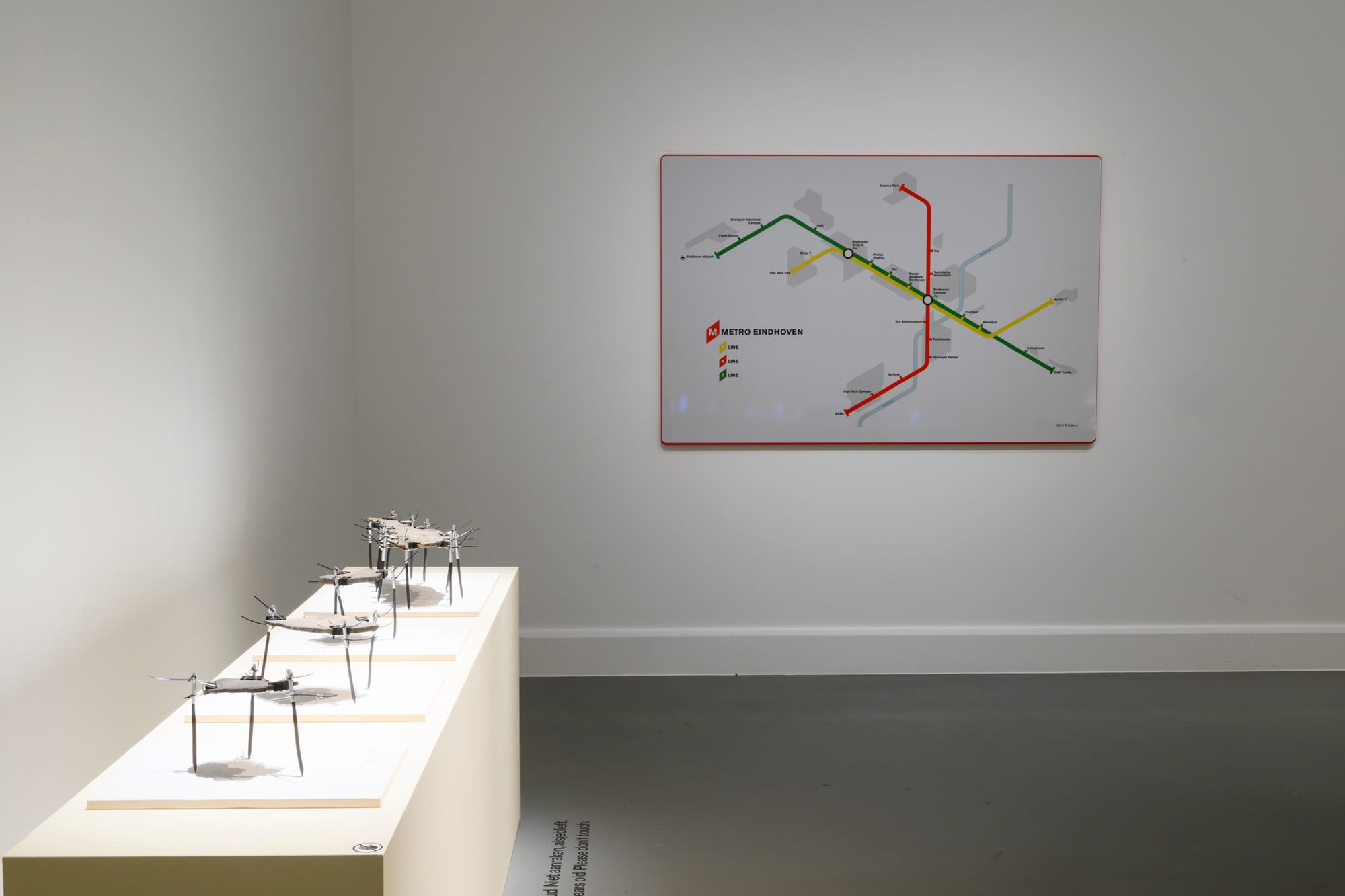
Eindhoven is growing and transforming. An archaeologist explained to us how excavations are tied to construction projects and how construction companies finance that work before putting up the buildings. That relationship between urban development and archaeology interests me a great deal. When the museum was extended, there was an excavation; in the region, vestiges keep being found, including with the expansion of companies like ASML.
Future and past converge on the same horizon. That idea also runs through the works of Gala Porras-Kim and Ana Maria Millan: archaeology is part of the present and of the decisions with which we build public space.
MIPL: We’re in the center of the building, lying on Ayumi Paul’s work. How does this room become a sundial?
AC: The floor plan has ten galleries: nine around a central one. That arrangement made us think of a sun, a center from which different vectors radiate. Ayumi works precisely in that central room.
The work marks the points on the horizon where the sun rises and sets. It’s as if it erased the museum’s walls—or made them transparent—to let us see beyond. It also includes a horizon situated six hundred years in the future. It opens space and, [simultaneously], opens time.
Museums promise eternal life, an idea that also appears and is questioned in “Collection as Cosmos”. But this museum opened in 1936. Thinking that in six hundred years the sun will still be traveling those same paths gives us a certain humility.
MIPL: The mulberry paper seems to hold the warmth of the sun. Does light also transform the material?
AC: Ayumi uses mulberry paper from Kurotani-cho, a village near Kyoto that has produced this paper traditionally for hundreds of years, including a sun-drying process. That warmth extends to the tatami, which is the heart of the room: a place to rest and to listen.
Ayumi’s work coexists there with an archive of traditional Brabant songs. The archive was started by the father of one of our benefactors, who was a music teacher in a village in the region called Weebosch. His students sang songs he had never heard and for which he knew of no recordings. He began to record them; then the grandparents also wanted to contribute theirs. The municipality ended up funding two days of work per week to organize the archive.
It’s a beautiful story of oral transmission. The songs accompany the cycles of life: getting up to work, returning home, resting. Sound organizes social life, just like architecture and the sun.
MIPL: Ayumi Paul also works with music. What happens when her work shares space with those voices?
AC: This is a commission conceived specifically for the site. We told her about the archive and proposed that she share the room. She loved putting her musical practice in conversation with the region’s sound histories.
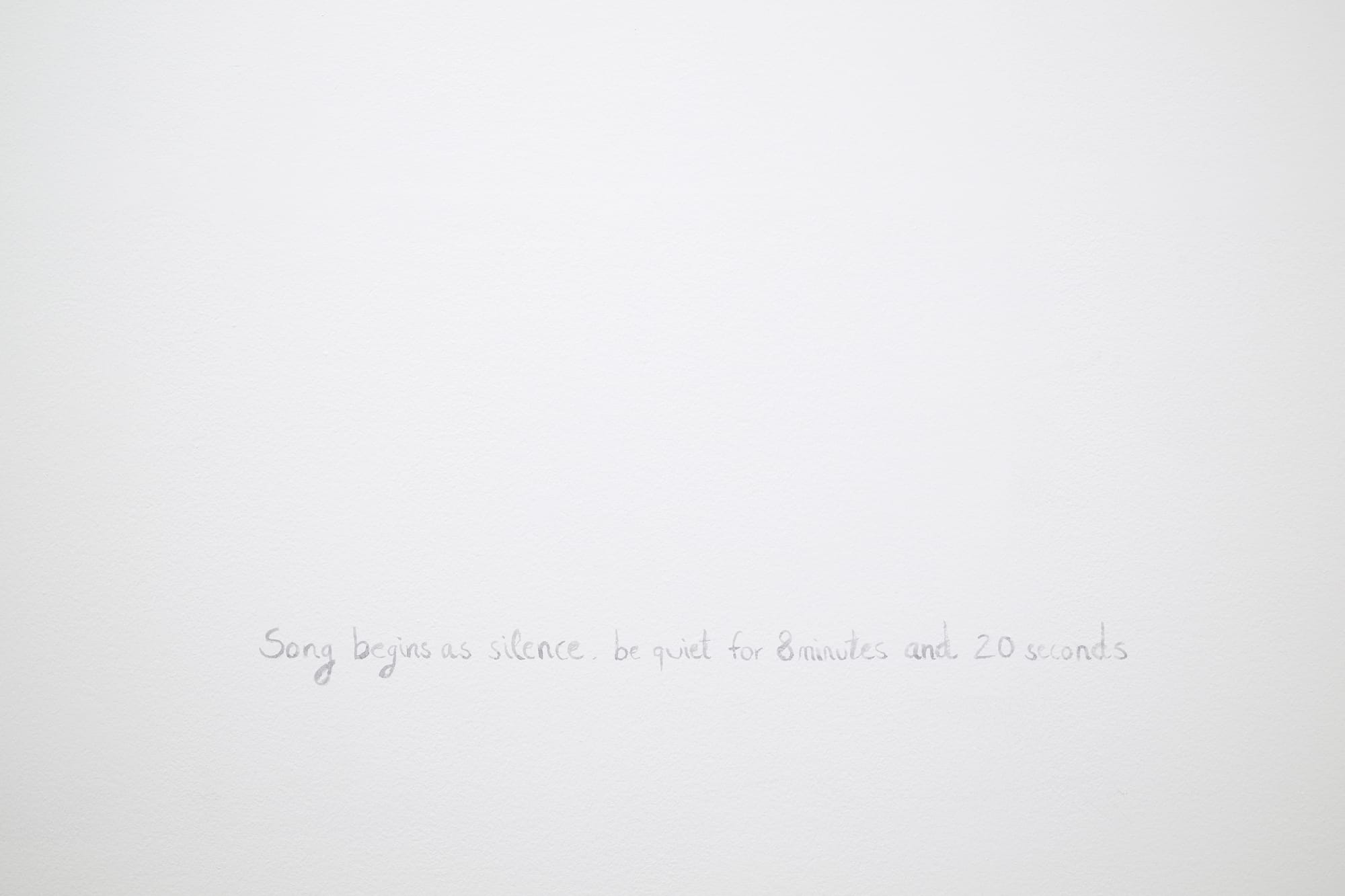
What she offers is a space for listening. You can meditate or rest on the tatami, but also do something as simple as stopping to listen to those small stories.
MIPL: From that stillness we move on to the play of Ei Arakawa-Nash. How do you invite different generations to share a museum?
AC: That’s one of the reasons we mixed those three models. We want a truly intergenerational museum. The exhibition isn’t dedicated exclusively to children: the works allow different generations to meet.
Here anyone can draw on the floor. The work reactivates the Gutai group’s first large outdoor group exhibition in postwar Japan, in Ashiya Park, where the public was invited to draw freely. By bringing that gesture inside the museum it changes our relationship with the architecture. In a heritage building you can do something that would normally be forbidden.
MIPL: Who signs an image when an artist or a child makes it and nobody tells us which of the two it was?
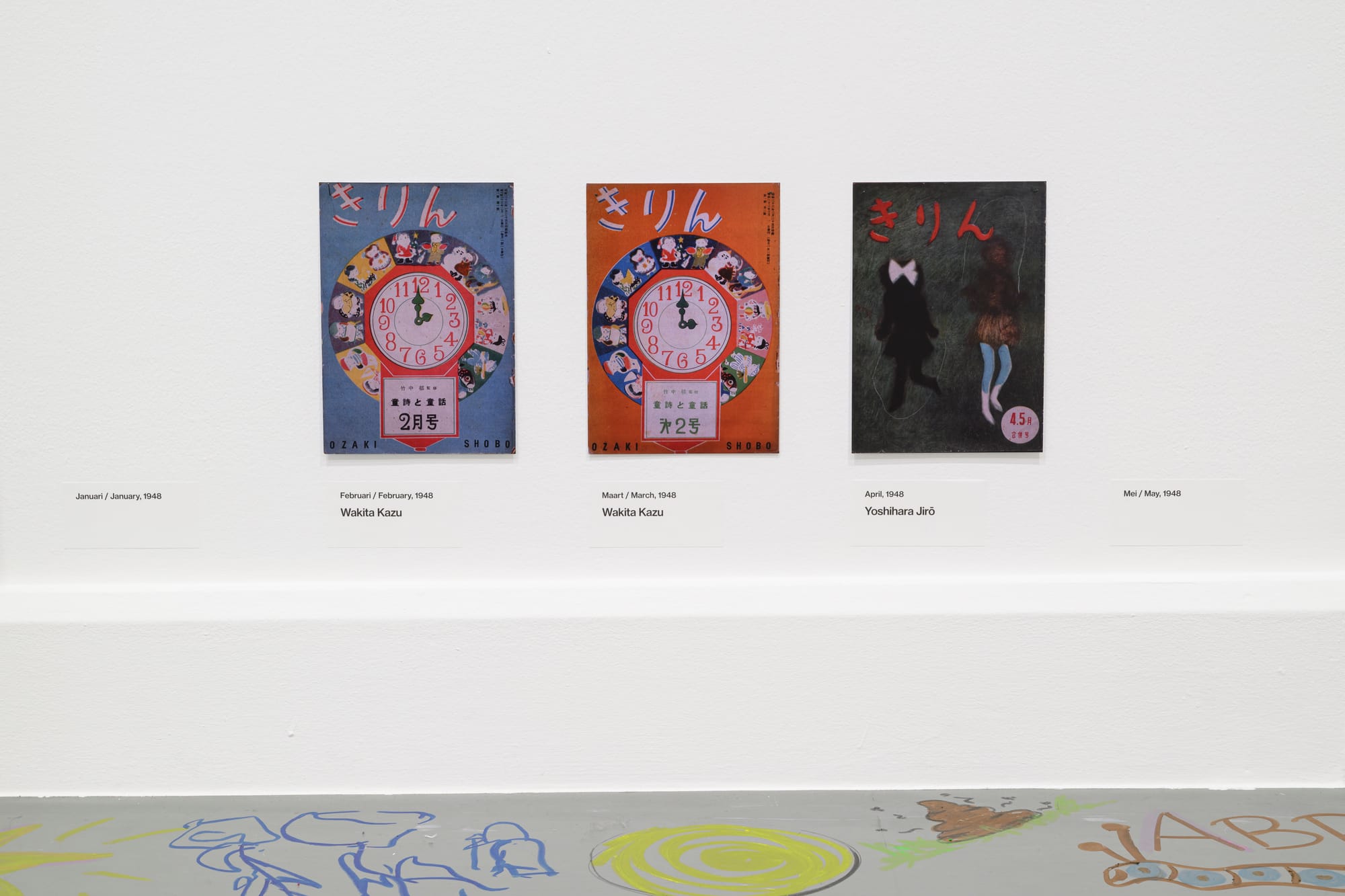
AC: That question is at the heart of Kirin, the magazine whose name means “giraffe” in Japanese. Its covers could be made by members of Gutai or by schoolchildren, without indicating who had made each one. That intergenerational collaboration is fundamental.
In Mega Please Draw Freely, the archive is part of the work and accompanies it every time it is installed. Here we decided to give it a more visible presence in the architecture. In conversation with the artist and the exhibition designer, Diogo Passarinho, we arrived at this configuration of two towers: they underline the building’s symmetry and at the same time bring the magazines closer to the floor. The height changes the way you relate to them.
MIPL: Each threshold seems to change the rules of the route. What role does design play in these movements?
AC: With Diogo we talked a lot about the relationship between the private and the public. You’re inside a building, but that building is a public institution that we want to open up more. He compared it to a simulation or a game in which you move from one place to another.
First, we are in Japan. Then, with the Italian primary school children who work with Adele. Later on, at Göbekli Tepe with Gala. We wanted to make those transitions perceptible. Together with Remco van Bladel, who is responsible for the graphics, we looked for a playful way to mark them.
The pedestals with Remco’s printed design were reused from a previous project of Diogo’s. That decision is also part of an archaeology of the institution itself: we excavate the archive’s histories and, at the same time, review what the museum keeps and what it discards.
MIPL: In Adele Dipasquale’s work, children imagine that words disappear. What remains of the world when we no longer know how to name it?
AC: Adele made and co-directed the video with a group of children who are just beginning to learn to write. She asked them what would happen if words disappeared, if they forgot language and no longer knew how to speak. One of the answers was: “I would grow horns.”
From there they built an entire imaginary, including the costumes, which they also designed together in collaboration with Anouk van Klaveren and Dewi Bekker. The work explores what happens outside verbal language: how we communicate with the body, gestures, and glances.
MIPL: As we cross over to Gala Porras-Kim’s work the light changes again. Are we seeing a sunrise or a sunset?
AC: Both. The complete work spans twenty-four hours; here we see the odd hours. Gala turns Göbekli Tepe, in present-day Turkiye, into a clock that changes with the sunlight.
Asymptotes Towards an Ambiguous Horizon brings together two times that never touch. The site appears as it was in 2021, but the position of the sun and stars corresponds to the sky of twelve thousand years ago, when its construction began. The site’s present and its ancestral sky share one image.
MIPL: We end in a room of drawings, books, and finger paintings. Whose childhood does an archive keep?
AC: This is one of my favorite rooms. It brings together the worlds that children create, from drawing to a practice as bodily as finger painting.
A volunteer asked me if it was “the children’s room”. I answered that some of those drawings were from the seventies: the people who made them could be starting to become grandparents today. The room also speaks of those languages of childhood that work through form and color rather than words.
But those worlds can be interrupted by war and displacement. It matters to me to insist that children are not an abstraction. They are political subjects: they live in the world, they go hungry. They can create worlds and also see them destroyed by war.
MIPL: How is that political awareness translated into an action by the museum?
AC: One of our colleagues, a security guard, Shafiq, proposed the project and put us in touch with AMURTEL, a foundation that brings water and food to Gaza. The initiative raises funds through the sale of drawings by displaced Palestinian children in Cairo who attend the Miira Daycare Center.
Right now, the fundraising is still open. Each drawing costs 29 euros, and everything raised, except for production costs, goes to the cause.
MIPL: The children’s books we see here also talk about war. What can art tell children about the things we usually protect them from?
AC: This selection of artists’ books comes from a private collection in Germany. It allows us to address matters that we sometimes reserve for adults, such as war and the atomic bomb.
There is a book by Umberto Eco in which the atoms of a bomb rebel because they don’t want to be used to kill children. Today it might strike us as a very explicit way of talking about the subject, but it’s an incredible way of approaching that history and the role of technology.
MIPL: Next to those books is Rhoda Kellogg’s archive. Can a drawing be read before words exist?
AC: Kellogg was a kindergarten teacher in San Francisco. She collected her students’ drawings and organized them into a mandala according to their abstract configurations: a kind of lexicon of forms that she recognized in [the] children’s production.
Here we see her finger paintings and a film made at her school in 1965, in which a filmmaker records how she teaches them that practice. We’re interested in that direct relationship between body, form, and color.
MIPL: Fingers trace circles and the route returns to its starting point. What place do Anne Frank’s mandalas have here?
AC: They are a very special loan: four drawings she made a year before going into hiding. In talking with the curator of the Anne Frank House, a letter to a friend also came up, in which she lamented not being able to go to the swimming pool because of the prohibitions against Jewish families.
It’s important to situate those drawings in the political life of the person who made them. They allow us to approach Anne Frank as a girl who drew and played, and whose everyday life was being restricted by persecution.
MIPL: How did those drawings come to the exhibition?
AC: At first we wanted to borrow her marbles. Defne had seen them in an exhibition in Germany and thought of incorporating them into our curatorial research. On the other side of this gallery there is an installation with marbles, and we were interested in putting them in relation. But Anne Frank’s marbles were part of the permanent collection and weren’t available.
Then something almost cosmic happened (I want to use that word deliberately): without knowing the rest of the objects in the room or the place the mandalas had in the exhibition, the collections manager offered us these drawings as another way of approaching how Anne Frank played and understood the world.
//